Svenska Dokumentmallar
Used cooking oil 2026 – collection permit, collection receipt and waste journal | Word/PDF/Excel
Used cooking oil 2026 – collection permit, collection receipt and waste journal | Word/PDF/Excel
- File format
- DOCX, PDF, XLSX
- Document language
- Five Swedish working documents Swedish User Guide and English User Guide; Swedish Excel workbook
- Number of files
- 7
Digital download. No physical product is shipped.
Couldn't load pickup availability
About this template
Used cooking oil from restaurants – new waste responsibility from 1 July 2026
Do you run a restaurant, café or commercial kitchen and have used frying oil or fat from a grill station? From 1 July 2026, the waste producer within the business itself is responsible for managing this specific waste stream. With this digital template package, you document the waste involved, the collectors and transporters engaged, actual collections and certificates of receipt.
Package contents
15 customer files in ZIP: seven editable DOCX and seven matching searchable PDFs, including five Swedish working templates and two user guides (Swedish and English). It also includes an Excel workbook with nine tabs in Swedish. Digital delivery when the download file is linked to the product.
What the files contain
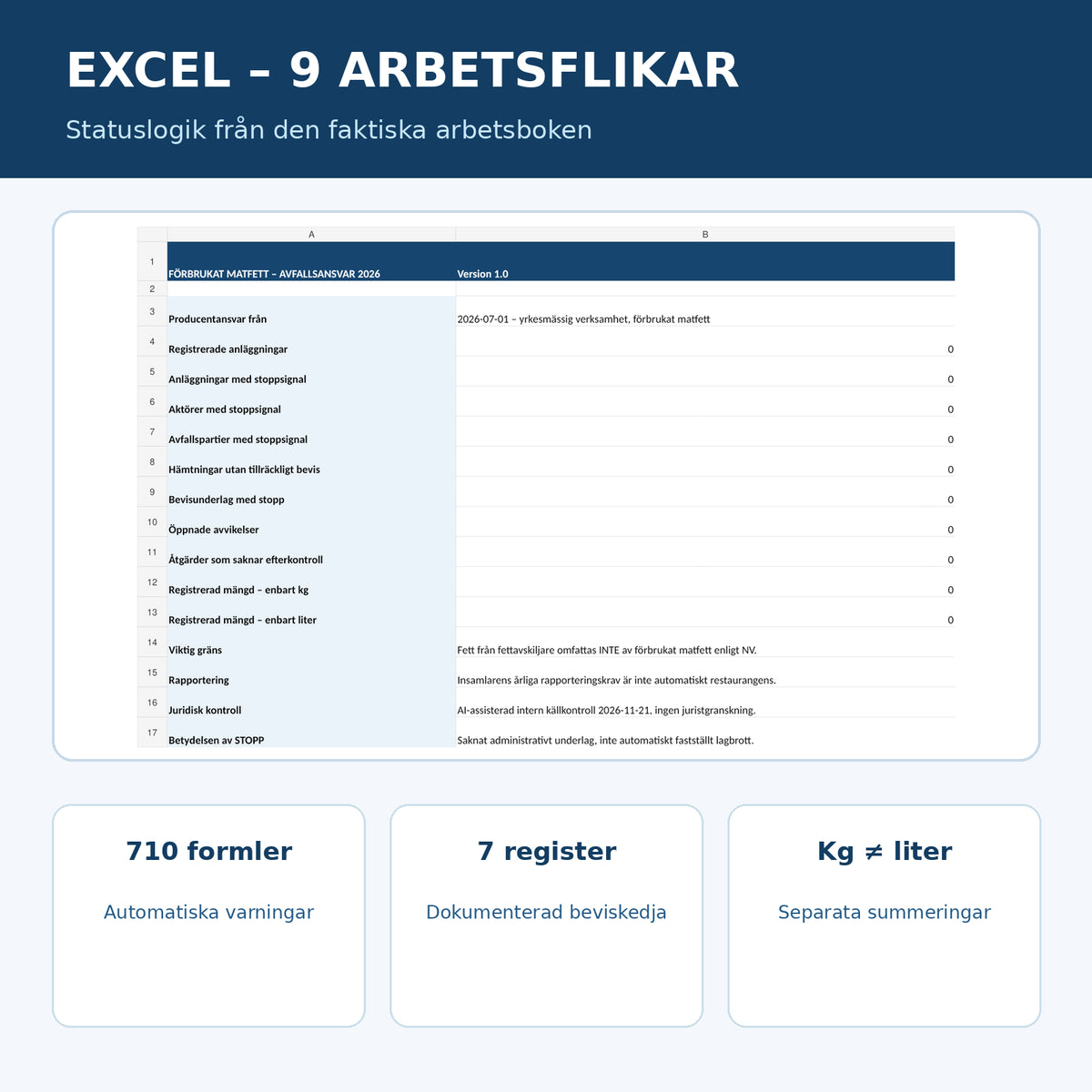
Responsibility map and waste assessment, documentation of the collector's authorization, container rounds and sorting, actual certificates of transfer, receipts, non-conformities and follow-up checks. The Excel file contains 710 formulas and administrative stop signals for missing documentation.
The five working templates
- Responsibility assessment and classification: distinguish used cooking oil from grease trap waste, other bio-waste and potentially contaminated waste. Document the actual basis for classification, without inventing waste codes.
- Collection agreement and authorization check: check of the transporter, collector, permit/notification, scope of the assignment, processor and original certificate.
- Container rounds and sorting: handling, labeling, spill risk, non-conforming mixtures and collection readiness.
- Certificate of transfer for cooking oil: collection date, actual quantity, unit (kg or liters), recipient, receipt and chain of custody.
- Non-conformity and corrective action: incorrect collection, leakage, missing receipt, unauthorized transport and verified follow-up check.
Excel with nine tabs
Overview, Facilities, Operators, Batches, Collections, Certificates, Non-conformities, Actions and Read me. The workbook contains 710 formulas, 11 registered list checks and tested warning signals. For example: a missing collection receipt triggers STOP even if the waste is stated as collected. Kg and liters are totaled separately. STOP is an administrative control signal, not a confirmed legal violation.
Legal boundaries
Used cooking oil is not the same waste as fat from grease traps. The Swedish Environmental Protection Agency expressly distinguishes between them. The business must check that the selected waste contractor is authorized to collect and transport the relevant fraction, as well as applicable local rules and waste classification. The rules on annual reporting to the Swedish Environmental Protection Agency apply to professional collectors and certain other reporting entities; they do not automatically mean that every restaurant must submit the same report.
Frequently asked questions
Who is responsible for used frying oil after 1 July 2026?
The waste producer in the professional business is responsible for arranging proper waste management. Hire an operator with the necessary permits or notifications for the assignment.
Does grease trap emptying apply?
No. Fat from grease traps is not used cooking oil within the meaning of this rule change. See separate template for grease trap operation and emptying.
Can the restaurant determine the waste code itself?
The business is responsible for correct classification, but the waste code must be supported by the actual composition and origin. Neither the documents nor the Excel file automatically assign a general code.
Must all restaurants report waste quantities to the Swedish Environmental Protection Agency every year?
No, the new specific reporting requirements apply, among others, to those who professionally collect municipal waste. Special rules may apply if a business processes the waste itself.
What happens if no waste contractor is available?
Under certain conditions, the municipality may have secondary responsibility upon a justified request, for example in the absence of handling services or unreasonably long transport distances. Document the actual circumstances.
Is a special official transport form required for all cooking oil?
Not generally, solely because the fraction is used cooking oil. Additional obligations may arise depending on classification and operator. This template package does not replace any official reports or prescribed transport documents.
What is the difference from general waste transfer?
This package is specialized for the cooking oil responsibility from July 2026, the grease trap boundary, kitchen routines, collector assessment and units of measure. The general waste transfer template is available here.
Legal sources
- Swedish Environmental Protection Agency: the reform of waste responsibility
- Environmental Code (1998:808)
- Waste Ordinance (2020:614)
- Swedish Environmental Protection Agency: waste transport within Sweden
- County Administrative Board: check waste transporters
Internal AI-assisted legal source check 2026-11-21. No independent legal review, official review or classification of the individual customer's waste has been performed.