Svenska Dokumentmallar
Vehicle Lift 2026/2027 – Inspection Log, Daily Inspection, User Authorization & Return to Service | Word/PDF/Excel
Vehicle Lift 2026/2027 – Inspection Log, Daily Inspection, User Authorization & Return to Service | Word/PDF/Excel
- File format
- DOCX, PDF, XLSX
- Document language
- Five Swedish work templates Swedish user guide English user guide and Swedish Excel register
- Number of files
- 7
Digital download. No physical product is shipped.
Couldn't load pickup availability
About this template
Vehicle Lifts 2026/2027 – Inspection Log, Daily Inspection, User Authorization and Return to Service is a digital template package for employers with vehicle lifts in car workshops, tire shops, and service facilities. Document every lift, the regular inspection month, inspections and service actually performed, the documented knowledge and written authorization of personnel, as well as safety deficiencies and separate return-to-service decisions.
The package applies to whole-vehicle lifting devices intended for work under the raised vehicle. It is an administrative documentation aid, not a technical user manual or an inspection certificate.
Package Contents
15 customer files: 7 editable Word files (DOCX), 7 corresponding searchable PDF files, and an Excel register (XLSX) with six tabs. Five Swedish work templates, a Swedish user guide, and an English User Guide. Digital download as a ZIP, version 1.0.
What the Files Contain
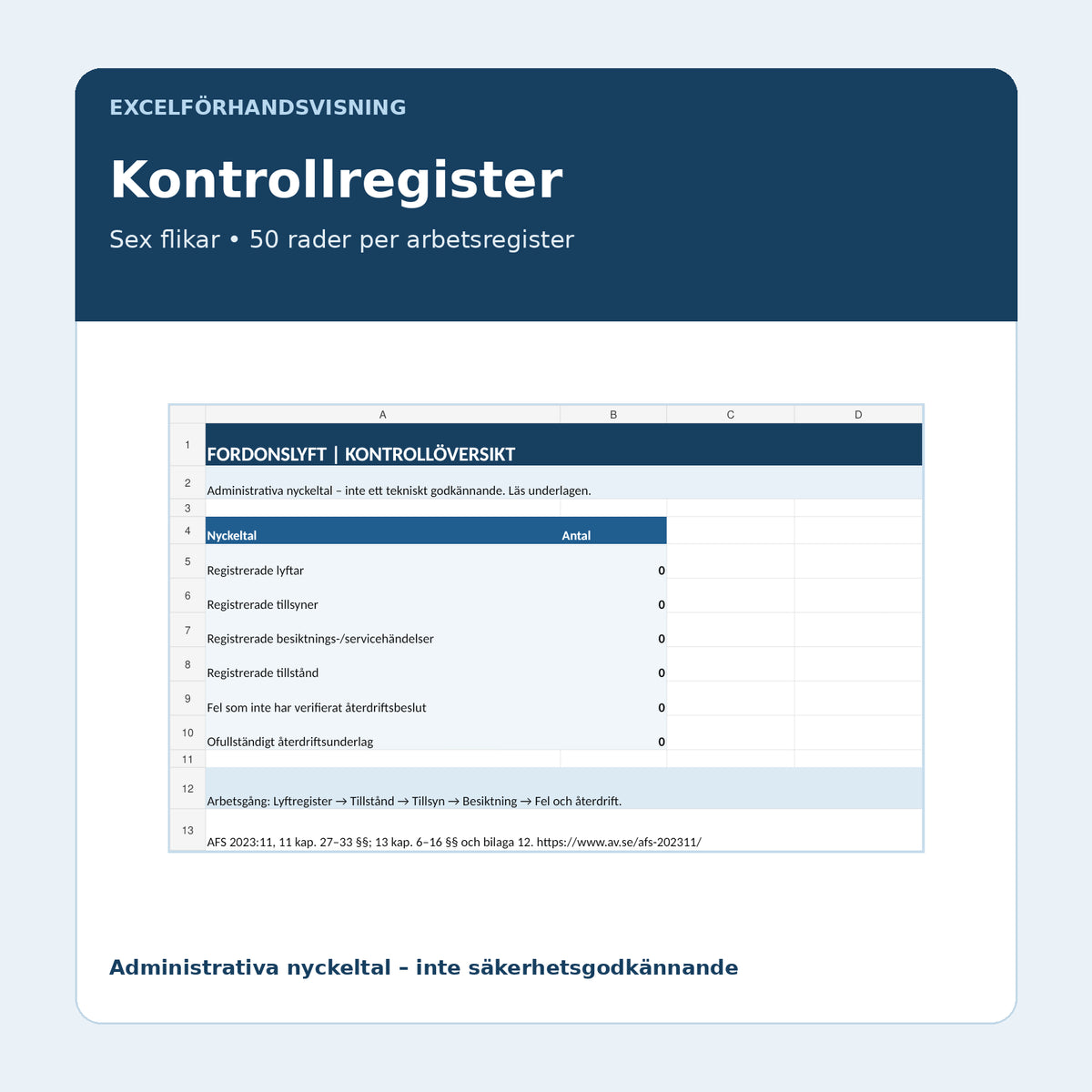
Lift register with model, serial number, and inspection basis; daily inspection; inspection and service log; written user authorization; decommissioning and documented return-to-service decision. Excel collects six administrative key metrics and control flags for missing information, duplicate IDs, and incomplete decisions.
Who Is the Template Package For?
For employers, workshop managers, supervisors, and occupational health and safety officers who use vehicle lifts and need to keep together actual documentation from daily inspections to inspections and follow-up on corrective actions. For stationary goods lifts, there is a separate template package for lift tables and scissor lift tables. For portable lifting equipment, there is a control log for lifting equipment. This package does not apply to pallet jacks, tail lifts, or personnel lifts.
Document List
| Document | Function | Format / Language |
|---|---|---|
| 01 Lift Register and Inspection Program | Identify lifts, maximum load, operating status, inspection interval, certificates, and responsibilities | DOCX/PDF · Swedish |
| 02 Daily Inspection | Document risk-free observations according to instructions and report deficiencies | DOCX/PDF · Swedish |
| 03 Inspection and Service Log | Distinguish between planned and actually performed events, document the report and the regular month | DOCX/PDF · Swedish |
| 04 Written User Authorization | Document the knowledge basis, work tasks, and the employer's issuance | DOCX/PDF · Swedish |
| 05 Decommissioning and Verified Return to Service | Fault, decommissioning, actual correction, possible re-inspection, post-inspection, and manual decision | DOCX/PDF · Swedish |
| 06 User Guide | Workflow, examples, and legal sources | DOCX/PDF · Swedish |
| 07 English User Guide | English guidance for the Swedish templates | DOCX/PDF · English |
| 08 Control Register | Six tabs, status lists, and administrative control flags | XLSX · Swedish |
Excel – Control Register for Vehicle Lifts
The workbook contains Overview, Lift Register, Inspection, Inspection Log, Authorization, as well as Faults and Return to Service. Five work registers have 50 prepared data rows each. The Overview shows the number of registered lifts, inspections, inspection and service events, authorizations, faults without a registered return-to-service decision, and incomplete decision documentation. The controls highlight duplicate IDs, unknown lift IDs, and incomplete information, including missing fault references for noted deficiencies and missing decision documentation for registered return-to-service.
A control flag is an administrative indicator. Excel does not calculate the legal last inspection date, does not replace the inspection body's certificate, and never approves equipment for use. Adapt the inspection program to the manufacturer's instructions and the organization's risk assessment.
How to Work with the Templates
- Identify each vehicle lift with a unique ID and collect actual instructions, certificates, and documentation on commissioning. Note the regular inspection month according to the certificate.
- Assess which controls and inspections are required; plan daily checks, ongoing inspections, service, and recurring inspections.
- Document practical and theoretical knowledge and issue limited written authorization according to applicable regulations.
- Perform only checks that personnel can perform safely and according to the model's instructions. Document actual observations, not assessed items and deviations.
- If a deficiency could jeopardize safety, it must be corrected before continued use. Document decommissioning, the correction actually performed, and assess the possible need for re-inspection.
- Save reports and certificates, follow up on conditions, and document a separate manual return-to-service decision only when the authorized person can assess the documentation.
Example (fictional): A safety deficiency is noted on L-01 in T-01. Register F-01, prevent use according to local safety procedures, and save the actual correction and post-inspection. A registered return-to-service decision without a post-inspection date, evidence reference, or decision date generates a control flag. A complete register is not equivalent to technical safety.
What Regulations Apply to Vehicle Lifts?
Swedish Work Environment Authority regulations AFS 2023:11, Chapter 11, Sections 27–28, covers knowledge, documentation, and written authorization for machine-driven lifting devices. Sections 29–33 regulate, among other things, maintenance, daily checks, ongoing inspections, inspections after dismantling, record-keeping, and deficiencies that could jeopardize safety. In Chapter 13, Sections 6–16, and Annex 12, there are inspection regulations and documentation requirements. Annex 12 specifies a 12-month interval for recurring inspections of vehicle lifts. The regular inspection month and rules for early or late inspections follow Chapter 13, Section 10. Installation inspection and re-inspection are assessed separately, with applicable exceptions. Follow the inspection body's decision and conditions. See also Swedish Work Environment Authority guidance on maintenance and control.
Legal sources checked November 26, 2026. No independent legal or technical expert review. The templates do not replace training, risk assessment, technical inspection, manufacturer instructions, accredited inspection, or assessment in the individual case.
File Format and Language
Unzip the ZIP file before use. The Word templates are editable; the PDF files are searchable and intended for reading and printing, not as interactive forms. The Excel register is in Swedish and requires spreadsheet software with support for XLSX, formulas, and tables. An English guide explains the Swedish templates. No macros or automatic safety alarms are included.
Frequently Asked Questions About Vehicle Lifts and Inspection Logs
How Often Should a Vehicle Lift Be Inspected?
Recurring inspection normally has a 12-month interval according to Annex 12 to AFS 2023:11. Start from the regular inspection month in the certificate and the rules in Chapter 13, Section 10; special decisions or circumstances may affect the assessment.
Is Daily Inspection the Same as Inspection?
No. Daily checks and ongoing inspections are the employer's ongoing responsibility. Prescribed inspection is performed by an inspection body according to the inspection regulations.
Do Personnel Need Written User Authorization?
For machine-driven lifting devices, requirements for the employer's written authorization apply according to Chapter 11, Section 28. The authorization covers specified types and tasks and presupposes documented competence.
What Happens if the Lift Shows a Safety Deficiency?
Deficiencies that could jeopardize safety must be corrected before continued use. Document decommissioning and let competent personnel assess the correction, the possible need for re-inspection, and return to service.
Is an Official Inspection Certificate Included?
No. The inspection certificate is issued by the inspection body. The log helps you register and follow up on actual certificates.
Does Excel Automatically Calculate the Next Legal Inspection Date?
No. Register the regular month from the actual certificate. In case of uncertainty, early inspection, or modified equipment, check the correct interval and any conditions with the authorized party.
Can the Package Be Used for Multiple Lifts?
Yes, through unique lift IDs and the five work registers with 50 prepared rows per register.
Can I Use the Template as Proof of Training?
No. The authorization template documents actually assessed knowledge and an employer decision; it is not a course or a training certificate.