Svenska Dokumentmallar
Wood dust in woodworking 2026/2027 – Risk assessment, extraction, measurement basis & CMR register | Word/PDF/Excel
Wood dust in woodworking 2026/2027 – Risk assessment, extraction, measurement basis & CMR register | Word/PDF/Excel
- File format
- DOCX, PDF, XLSX
- Document language
- Five Swedish work templates Swedish user guide and English User Guide
- Number of files
- 7
Digital download. No physical product is shipped.
Couldn't load pickup availability
About this template
Wood dust in woodworking and the wood industry – occupational health and safety templates for 2026/2027
Do you work with sawing, planing, routing or sanding wood? Document the risks of wood dust from source to control measure with a practical package for employers, woodworking shops and furniture manufacturers. You will receive five Swedish work templates, two guides and an Excel register for wood species, dust sources, risk assessment, technical elimination, local exhaust ventilation, occupational hygiene measurement data and CMR register review.
The clarification that applies from 9 April 2026 in AFS 2023:10 means that work involving wood dust from deciduous trees, among other things, may not be carried out if the exposure can be technically eliminated. Dust from deciduous trees is also covered by special provisions for carcinogenic exposure. A measured value below the limit value does not replace the assessment of elimination or measures to reduce exposure.
Package contents
Five Swedish work templates, a Swedish user guide and an English User Guide – each in editable Word (DOCX) and searchable PDF – as well as an Excel register with nine tabs. A total of 7 Word files, 7 PDF files and 1 Excel (XLSX) = 15 customer files in a digital ZIP delivery.
What the files contain
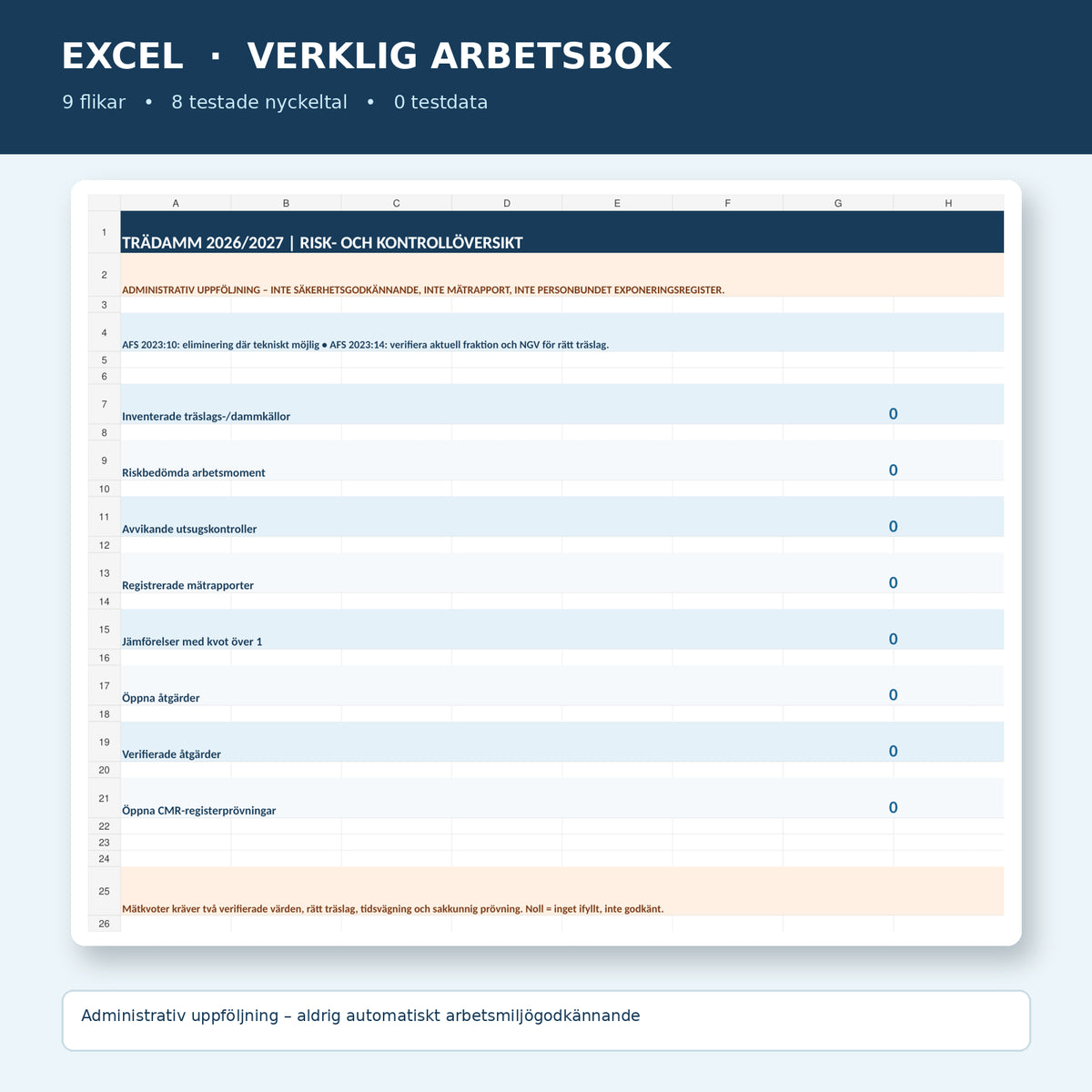
Inventory of dust sources and wood species, documented assessment of technically feasible elimination, control log for local exhaust ventilation and cleaning, decision on measurement and review of actual measurement reports, as well as a separate Word template for CMR register assessment and follow-up. The Excel file provides an impersonal administrative index with eight tested key figures and a simple ratio for verifiable comparable measurement values.
Which wood species and work steps are covered?
The package distinguishes between deciduous wood (hardwoods), coniferous wood (softwoods), pressure-treated timber and mixed/unknown materials. According to AFS 2023:14 Annex 1, the following occupational exposure limit values apply for inhalable dust at the time of this product's source control on 22 November 2026:
| Dust category | OEL (mg/m³) | Special control |
|---|---|---|
| Deciduous wood / hardwoods | 2 | Assess CMR rules and any register requirements. |
| Coniferous wood / softwoods | 2 | Document the same basic chemical risks. |
| Pressure-treated timber | 0.5 | Also investigate risks from treatment substances. |
| Mixture or unknown material | No automatic conclusion | Check correct application and measurement fraction with an expert. |
Limit values are binding but are not safety guarantees. A measurement must relate to the correct dust fraction, representative work and a relevant time-weighted average. The employer must assess cumulative risks, dust dispersion and preventive measures.
All 15 customer files
| File | Work step | Language | Format |
|---|---|---|---|
| 01 | Wood species, dust sources and written risk assessment | Swedish | DOCX + PDF |
| 02 | Elimination, alternatives and control measure decision | Swedish | DOCX + PDF |
| 03 | Local exhaust ventilation, ventilation and dust-safe cleaning | Swedish | DOCX + PDF |
| 04 | Measurement requirements, original report and exposure data | Swedish | DOCX + PDF |
| 05 | CMR register review and control measure follow-up | Swedish | DOCX + PDF |
| 06 | User guide with legal control points | Swedish | DOCX + PDF |
| 07 | English User Guide – guidance for Swedish templates | English | DOCX + PDF |
| 08 | Wood dust – administrative risk and exposure register | Swedish | XLSX |
Excel with nine tabs and actual functional tests
The workbook contains Overview, Start, Wood species, Work step, Exhaust ventilation, Measurements, Control measures, CMR index and Sources. Eight key figures show, among other things, registered risk sources, controls, measurement data, deviations, open and verified control measures and the need for further register review. The file is delivered without pre-filled cases or example persons.
In the Measurements tab, Excel can calculate the ratio actual measured value / manually verified limit value, but only when both figures are provided. The function is mathematically tested with 0.8/0.5 = 1.60 and 0.8/2.0 = 0.40. It does not determine whether the measurement is representative, whether the wrong dust fraction was used or whether work may continue.
Important for personal data: The Excel index is not a personal CMR exposure register. Do not enter personal names, personal identity numbers, individual exposure or medical data in the spreadsheet. Any personal register required by AFS 2023:10 Chapter 8, Section 20 must be established in the employer's secure, access-controlled system, with the correct retention period.
How to use the package
- Inventory wood species and processes: map work steps that generate dust and document actual exposure.
- Assess elimination first: document whether the work step or dust source can be avoided using technically feasible alternatives.
- Check local exhaust ventilation and cleaning: record actual operational controls, deficiencies and control measures without automatic approvals.
- Assess the need for measurement: obtain an occupational hygiene report when a reliable assessment cannot be made in any other way; also document the reasons for deciding against it.
- Follow up properly: conduct a separate CMR assessment when deciduous wood dust is relevant, decide on protected registers and retain evidence of control measures and re-inspections.
Frequently asked questions
Is wood dust carcinogenic?
Exposure to dust from deciduous trees is expressly covered by the special CMR rules in AFS 2023:10. Research highlighted by the industry organisation TMF in June 2026 also shows long-term risks from occupational exposure to wood dust. This does not mean that a new lower binding limit value has been introduced.
Do we always need to measure the wood dust content?
Not automatically. The employer must carry out occupational hygiene measurements if the content cannot otherwise be reliably assessed as acceptable in relation to the limit values. The reasons for the decision to abstain must be documented in writing. Special rules apply after measures to reduce air pollution.
Is it enough if the measured value is below 2 mg/m³?
No. For pressure-treated timber, 0.5 mg/m³ is specified for inhalable dust, and the wrong fraction or sampling conditions can make the comparison misleading. Even if the value is below the relevant limit value, the obligation to eliminate or reduce exposure according to applicable rules remains.
When are CMR registers required?
In relevant deciduous wood dust work and exposure to such an extent that it may pose a risk to health, Chapter 8, Section 20 may require a personal register of employees. It must be kept separate from the administrative Excel index in the package.
Can this template replace a technical exhaust control or measurement?
No. It provides documentation fields for actual controls, expert assessments and report references – not a technical testing method, a statement or a safety certification.
Are the PDF files digitally fillable?
The PDF versions are searchable and printable. They do not have promised interactive form fields. Edit in Word and use Excel for administrative follow-up entries.
Are all templates included in English?
The five work templates and the Swedish guide are in Swedish. The separate English User Guide explains how the Swedish documents are used.
Legal sources and product version
Product version 1.0, internal AI-assisted legal source check 22 November 2026. The documents are technically tested but have not been externally reviewed or approved by a lawyer, occupational hygienist or authority. Always check the latest legal wording and actual workplace conditions.
- AFS 2023:10 – chemical occupational health risks and special CMR requirements
- AFS 2023:14 – occupational exposure limit values for wood dust
- AFS 2023:10 – legislative history and amendment from 2026-04-09
- TMF – research results and practical measures
- Prevent – free general occupational health and safety template
Related general template: Chemical risks – risk assessment and safety instructions. This package is instead specialised for wood dust material groups, process exhaust ventilation, measurement comparisons and CMR register issues.