
Biocide-treated textiles in Sweden – antibacterial claims and 45-day replies

An online retailer promotes sports socks as antibacterial. A customer wants to know what substance was used. Regulation (EU) 528/2012, Article 58, calls for checking the product category, the active substance's legal status, claims, labels and the right to free treatment information within 45 days. These rules were already in force before 2026; the year is not a new starting date.
Treated article or biocidal product?
A textile treated to protect the material itself, for example from odour or decay, may be a treated article. If the main purpose is biocidal protection of the wearer against viruses or pests, it may instead be a biocidal product requiring a separate authorisation. Examine real function, claims and use; changing the advertisement does not automatically change the product's legal status.
Active substances, product types and transitional rules
Identify the precise active substance, product type and intended use. Article 58(2) restricts treated articles to permitted substances and applicable conditions. Article 94 contains transitional possibilities for some substances still under review; a missing final approval does not by itself resolve legal status. Check ECHA records alongside the actual approval conditions, date and product type. EU treatment may also require an authorised biocidal product.
Do not treat all silver compounds alike. The Swedish Chemicals Agency describes special conditions for silver zinc zeolite, product type 9, including use restrictions for some textiles. Confirm the exact substance and approval decision; never generalise one decision to every silver-treated garment.
Evidence for antibacterial and anti-odour claims
Terms such as 'antibacterial', 'anti-odour' or 'antimicrobial' call for investigation but do not by themselves prove which technology was used. Ask for batch-specific substance data, appropriate efficacy evidence and substantiation of the exact claim. Protecting the wearer against viruses or insects raises different classification issues from protecting the fabric against odour.
When must a textile be labelled?
Article 58(3) requires treatment-specific labels when the manufacturer claims biocidal properties or an active substance approval makes labelling necessary. Depending on applicability, state that a biocidal product was incorporated, the substantiated property, all active substances, relevant nanomaterials marked '(nano)', and use/safety instructions. Article 58(4) may also require precautions without advertising claims. Labels on goods sold in Sweden must meet Swedish-language requirements.
Consumer information: the 45-day rule
Under Article 58(5), a consumer can request information about the treatment free of charge within 45 days, even when the seller makes no biocidal claim. Record receipt date, product and batch, obtain supporting details from the supplier and answer accurately. Do not invent a 'not treated' statement if the supply chain cannot yet confirm the facts. A spreadsheet deadline is an aid, not proof of compliance.
Examples and a practical control trail
| Control | Evidence | Decision |
|---|---|---|
| Category | Function and claims | Treated article or biocidal product |
| Substance | Active, product type, approval or Art 94 | Legal status for this use |
| Claims | Testing and supplier substantiation | Keep, amend or remove claim |
| Label | Swedish text, actives, nano and warnings | Art 58(3)–(4) |
| Consumer request | Date, item, batch and reply | Free response within 45 days |
| Deviation | Affected batch and corrective action | Manual sales decision |
Scenario A: anti-odour sportswear is imported. Verify substance, product type, lawful use and efficacy, then check the Swedish label. Removing an unsupported claim does not cure an unlawful active substance.
Scenario B: a customer asks about treatment of an unadvertised garment. Register the request, trace the batch, get the supplier's evidence and send a free, documented reply within 45 days.
Frequently asked questions
Must all treated textiles have a special label?
Not solely because treatment took place. Article 58(3) applies when certain claims or approval conditions trigger it; Article 58(4) may require safety instructions regardless.
Does the 45-day rule apply without an antibacterial claim?
Yes. Consumers may request free information about a treated article's biocidal treatment independently of a marketing claim.
Are all silver-treated garments prohibited?
No. Check the exact active substance, product type and conditions. Restrictions for silver zinc zeolite are not universal rules for all silver compounds.
Official sources and other textile rules
PFHxA restrictions in clothing arise from separate REACH provisions, not Article 58. Do not conflate fluorinated-substance concentration limits with biocidal treatment obligations. General legal information; no testing or certified approval. Sources checked 16 November 2026.
Explore the topic
 Business guides – contracts, HR, AI & compliance
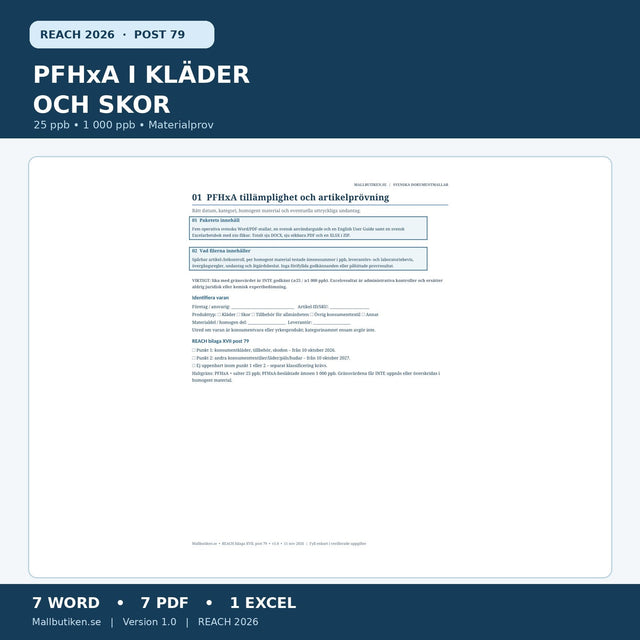
PFHxA in clothing and footwear – 25/1,000 ppb, test reports and old stock
PFHxA restrictions for clothing and footwear apply from 10 October 2026. Learn the 25/1,000 ppb material limits, laboratory evidence and the existi...
 Business guides – contracts, HR, AI & compliance
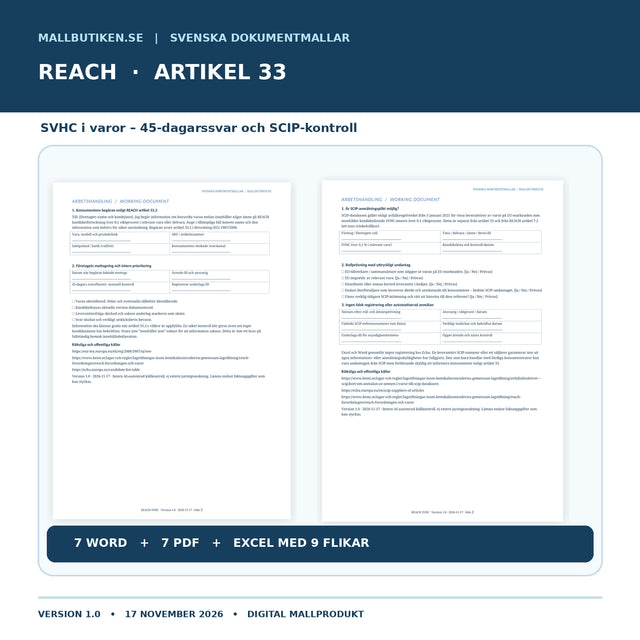
REACH Article 33: SVHC, 45-day replies and SCIP in 2026
When a customer asks whether a bike, garment or electronic product contains a substance of very high concern (SVHC), REACH Article 33 may require a...


