
REACH Article 33: SVHC, 45-day replies and SCIP in 2026
When a customer asks whether a bike, garment or electronic product contains a substance of very high concern (SVHC), REACH Article 33 may require a free reply within 45 days. That is not the same as making a SCIP submission.

When a customer asks whether a bike, garment or electronic product contains a substance of very high concern (SVHC), REACH Article 33 may require a free reply within 45 days. That is not the same as making a SCIP submission.
Swedish and EU law checked on 17 November 2026. This is general information, not a chemical test or ECHA submission.
What must a retailer do first?
Record the date the consumer's request arrived, identify the precise product and its components, check the current Candidate List and obtain traceable supplier evidence. Where an article or constituent article contains a Candidate List substance above 0.1% by weight, the supplier must provide sufficient safe-use information, including at least the substance name, free of charge within 45 days of receipt. Do not assert the product is SVHC-free without evidence.
Who is covered?
Article 33 applies to suppliers of articles, including importers, manufacturers, distributors and retailers. An article is an object whose shape, surface or design determines its function more than its chemical composition. Mixtures have different rules. The retailer cannot assume that a manufacturer previously informed the end consumer. Track the product code, variant and supplier.
Consumers versus business customers
Under Article 33(2), a consumer who requests the relevant information must receive it within 45 days, free of charge. Article 33(1) requires disclosure to professional recipients as part of supply, rather than only after a consumer request. Do not apply the 45-day consumer clock to B2B deliveries. Record the request date, delivery date and actual communication.
0.1% applies to constituent articles
The threshold is above 0.1% by weight in the relevant article, not necessarily the weight of a complete assembled product. Under EU Court case C-106/14, a component that qualifies as an article retains that status when incorporated into a larger object. For example, test the bicycle grip as an article rather than diluting its SVHC weight across the whole bicycle. A whole-product certificate may therefore be insufficient.
What to ask the supplier
Specify the product revision and individual component, the relevant Candidate List version, substance identity and concentration, and any safe-use instructions. Obtain traceable material declarations or test reports where needed. Set an internal response date before the consumer's deadline. A generic assertion that a product 'complies with REACH' does not necessarily establish the facts required for the customer reply.
If information is missing
An unknown concentration must not be treated as a verified negative result. Escalate missing evidence and chase the supplier. An interim status update may help customers but does not replace mandatory Article 33 information where the duty applies. If the investigation establishes no qualifying substance above the threshold, Article 33(2) does not impose the same explicit substance disclosure; nevertheless, a clear factual response is good practice. Never invent test results.
What must the consumer reply say?
Where the duty applies, include at least the Candidate List substance's name and sufficient information available for safe use. Identify the relevant component and product revision and keep evidence of sending the answer. Generic claims such as 'REACH approved' do not replace substance-specific information. Explain any documented limits of the evidence without declaring unsupported certainty.
SCIP is separate and retailers may be exempt
SCIP is a notification database under EU waste legislation, distinct from consumer communications under Article 33 and from the substance notification in REACH Article 7(2). EU producers, importers and distributors may need to submit information on articles with Candidate List substances above 0.1% by weight. Retailers supplying articles directly and exclusively to consumers are excluded from SCIP submission, according to ECHA and the Swedish Chemicals Agency. This does not remove their Article 33 duties.
REACH Article 7(2) is not SCIP
Some producers and importers face a separate notification under Article 7(2) when the concentration threshold is exceeded and the aggregate quantity of the substance exceeds one tonne per producer/importer annually, subject to exceptions. Keep separate review records for Article 33, Article 7(2) and SCIP. A SCIP reference alone does not prove that a customer received the required safe-use information.
Do not confuse biocidal treatment with REACH
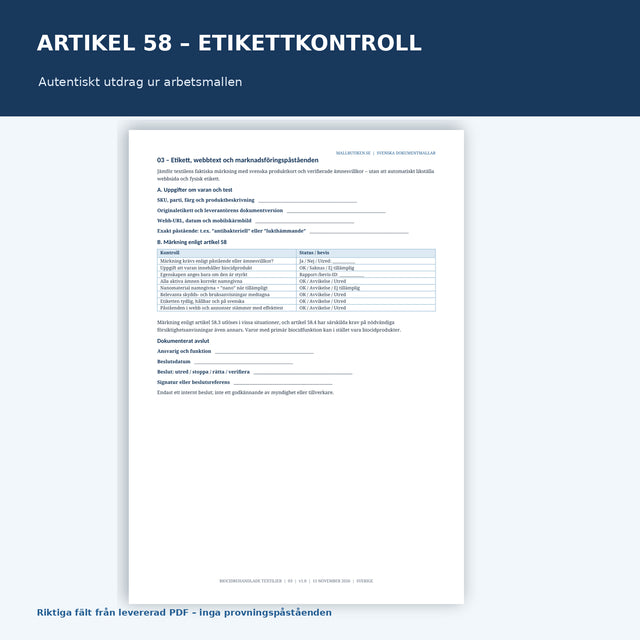
A treated textile may trigger Article 58(5) of the Biocidal Products Regulation, which also gives consumers a free 45-day information right about biocidal treatment. It is distinct from REACH Article 33 concerning Candidate List substances above the 0.1% threshold. A product may require one, both or neither assessment. See our separate guide on biocide-treated textiles.
Examples, checklist and FAQ
A customer asks whether a bicycle grip contains a plasticiser: track the grip itself and ask for verified component-specific data. A retailer selling exclusively to consumers may have Article 33 obligations but be exempt from SCIP submission. Record product and component, request date, Candidate List version, supplier evidence, substance name, safe-use advice, dispatch and role-specific SCIP review. Is every retailer required to file SCIP? No. Is 45 days the B2B deadline? No. Can a spreadsheet submit to ECHA? No.
Related guide: biocide-treated articles
Biocide-treated textiles – a separate 45-day rule
Official legal and regulator sources
- Kemikalieinspektionen – kandidatförteckningen och artikel 33
- Kemikalieinspektionen – Reach och varor, delvaror samt tröskel
- Echa – Communication in the supply chain (Article 33)
- Kemikalieinspektionen – SCIP och avfallsdirektivet
- Echa – Suppliers of articles and SCIP
- EU-domstolen C-106/14 – 0,1 % i delvaror
- Kemikalieinspektionen – biocidbehandlade varor
Explore the topic
 Business guides – contracts, HR, AI & compliance
Biocide-treated textiles in Sweden – antibacterial claims and 45-day replies
Swedish/EU guide to biocide-treated clothing: Article 58, permitted active substances, labels, marketing claims and consumer replies within 45 days.


