
F-gas when an operator changes in Sweden – handover, leak checks and records
When a shop, property or business changes the operator of refrigeration, air-conditioning or heat-pump equipment, handing over the keys is not enough. The incoming operator must know the equipment, refrigerants, inspections, outstanding defects and reporting obligations. This guide explains EU Regulation 2024/573 and Swedish Regulation 2016:1128 as applicable in November 2026.

When a shop, property or business changes the operator of refrigeration, air-conditioning or heat-pump equipment, handing over the keys is not enough. The incoming operator must know the equipment, refrigerants, inspections, outstanding defects and reporting obligations. This guide explains EU Regulation 2024/573 and Swedish Regulation 2016:1128 as applicable in November 2026.
The operator is not always the owner
Article 3(5) of Regulation 2024/573 defines the operator primarily by actual power over the technical functioning of equipment, or by a specific national designation of the owner. Ownership or invoice address alone is not decisive. Determine who can stop equipment, commission repairs, grant access and manage the technical operation. Record when control actually changes. A private contract cannot displace mandatory statutory duties.
Documents to transfer
Request an inventory by unit ID and location, refrigerant type, charge in kilograms, GWP and tonnes of CO₂ equivalent. Transfer leak-check certificates, additions and recoveries, repairs, service contracts, contractor certifications, labels and operating instructions. Put missing documents in a dated action log and assign an owner.
Leak inspections and certified maintenance
Article 5 sets leak-check thresholds. Generally, Annex I gases are covered at five tonnes CO₂e and Annex II section 1 gases at one kilogram, with exemptions for certain labelled hermetically sealed equipment. Intervals depend on the gas, quantity and leak-detection system. Check each unit separately; overdue inspections do not disappear when the operator changes. Applicable repairs and inspections require suitably certified contractors.
EU equipment records and the five-year rule
Under Article 7, records must be kept for each unit subject to leak checks. They include gas type and quantity, additions, recoveries, maintenance companies, certificates, inspection dates and results, and decommissioning actions. Unless a competent authority database holds the records, the operator must normally retain them for at least five years; relevant contractors also keep copies. Records need to continue through the handover, not start anew.
Swedish annual reporting: 14 tonnes CO₂e and 31 March
Swedish Regulation 2016:1128 section 15 requires an annual report if an installation subject to the provision contains at least 14 tonnes CO₂e during any part of a calendar year. The deadline is 31 March the following year. This is separate from the leak-check threshold for individual units. Where operators change during the year, preserve information for both periods and clarify with the authority who submits the report.
Notifying the competent authority
Ask the relevant municipal environmental office or other competent authority how an operator change must be notified. Helsingborg, for example, provides a local handover form referring to notice two weeks before the change; that is not a universal Swedish statutory period. Do not confuse an operator change with installing or converting equipment, for which a separate notification rule may apply under Swedish section 14.
Handover decision table
| Check | Before transfer | Handover record |
|---|---|---|
| Technical operator | Identify actual control and transfer time | Record both parties and responsibilities |
| Equipment inventory | List each unit, refrigerant, GWP and CO₂e | Log missing data |
| Checks and records | Obtain inspections, repairs and historic logs | Arrange overdue checks and five-year retention |
| Authority and report | Confirm local process and 14-tonne threshold | Assign report evidence and track 31 March |
Eight steps for a safe transfer
- Determine who exercised technical control before and after the transfer.
- Record the effective date, contacts and emergency service authority.
- Inventory each unit, label, refrigerant, GWP and CO₂ equivalent.
- Review recent leak checks, leaks, repairs and upcoming deadlines.
- Transfer complete records and five-year history where Article 7 applies.
- Verify contractor certification, service agreements and alarm procedures.
- Contact the authority about notification and annual reporting responsibility.
- Sign a handover protocol naming gaps, responsible persons and follow-up dates.
Two practical examples
A shop changes its operating company, not its landlord
Technical control may still shift. Verify who orders maintenance, hand over the logs, and allocate annual-report information across the year.
A property is sold without the last leak-check certificate
The incoming responsible party must assess the equipment, identify overdue checks and obtain qualified support. Record missing evidence and ask the local authority about notification.
Frequently asked questions
Does buying a property automatically make the buyer the operator?
Not necessarily. Actual technical control and any special national allocation of duties are relevant.
Must every unit undergo a new leak check at transfer?
The transfer alone does not universally trigger a fresh inspection. Check the applicable thresholds, exemptions, deadlines and outstanding defects.
Do five-year records survive an ownership change?
Yes, continuity is essential for equipment covered by Article 7; the usual retention rule is at least five years where there is no competent-authority database.
What if operators change in October?
Where section 15 applies, the reporting requirement concerns the calendar year and falls due the following 31 March. Clarify who submits the information.
Is two weeks the nationwide notification deadline?
No. That is an example of Helsingborg's local guidance. Check the responsible authority's requirements.
Official legal sources
- Regulation (EU) 2024/573 arts 3, 5, 7
- Sveriges riksdag – Förordning (2016:1128), 14–15 §§
- Naturvårdsverket – att rapportera till tillsynsmyndighet
- Naturvårdsverket – stationär kyl-, luftkonditionerings- och värmepumpsutrustning
- Helsingborgs stad – byte av operatör, lokalt formulär (PDF)
Read our separate published guide to F-gas GWP restrictions for air-to-water heat pumps.
When an operator change also involves a new service provider for a connected cooling system, data access may require a separate assessment. See our guide to EU Data Act, refrigeration sensor data and service-provider changes. Rules for data holders and users do not replace F-gas duties and do not automatically cover every installation.
Explore the topic
 Business guides – contracts, HR, AI & compliance
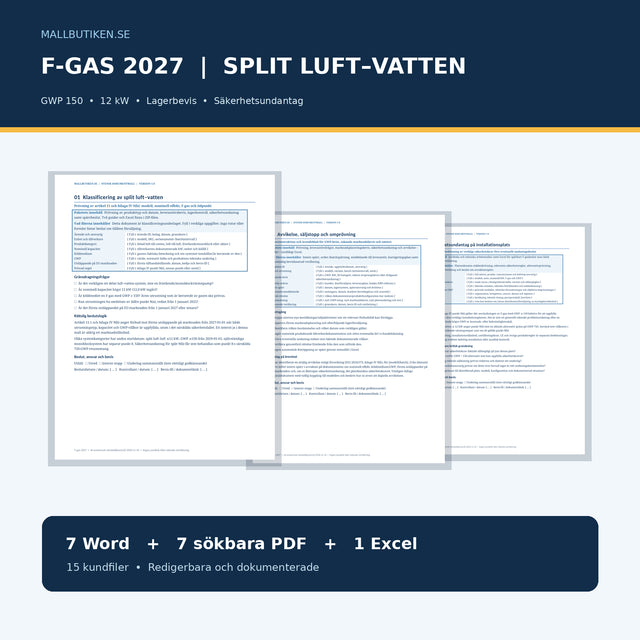
F-gas 2027: which split air-to-water heat pumps face the GWP 150 ban?
Guide to the January 2027 F-gas market ban for small split air-to-water heat pumps, including GWP thresholds, stock evidence and safety exceptions.
 Business guides – contracts, HR, AI & compliance
EU Data Act for refrigeration equipment – sensor data and service handover
Request temperature, alarm and pressure sensor data under EU Data Act Articles 4–5 and share eligible data with a new refrigeration service provider.


