
Selling fish online in Sweden 2026 – species, area and fishing gear
An online seafood retailer needs more than a product photograph. Under EU Regulation 1379/2013 Article 35, covered fishery and aquaculture products require species names, production details, origin and other consumer information. Article 14 of Regulation 1169/2011 governs online food information before purchase. The expanded EU traceability framework beginning in January 2026 must not be confused with Sweden's deferred practical rollout of certain digital requirements.

An online seafood retailer needs more than a product photograph. Under EU Regulation 1379/2013 Article 35, covered fishery and aquaculture products require species names, production details, origin and other consumer information. Article 14 of Regulation 1169/2011 governs online food information before purchase. The expanded EU traceability framework beginning in January 2026 must not be confused with Sweden's deferred practical rollout of certain digital requirements.
Swedish/EU law reviewed 17 November 2026. General information, not an official catch certificate or traceability submission.
Which fish products are covered?
Special Article 35 information applies to the groups in Annex I points (a), (b), (c) and (e), including many fresh, frozen and related fishery products. It does not automatically apply in the same way to every composite prepared meal containing fish. Assess the exact commodity code and processing method before copying a generic label to a product card.
Mandatory consumer information
For covered products, check the approved commercial designation and scientific species name, the method of production, relevant capture area or farming country, fishing gear category for caught products, thawed status where applicable, and the durability date where required. Other food information and allergen rules continue to apply. A statement such as 'fresh local fish' is not a substitute.
Species names and fishing method
Show both the appropriate national commercial name and scientific name backed by supplier evidence. Distinguish caught at sea, caught in freshwater and farmed fish. Use the appropriate gear category for capture products; never invent trawling or net fishing details for farmed goods. Check supplier records whenever stock or species changes.
Catch area and mixed lots
Use consumer-understandable names rather than only FAO numerical codes. In the North-East Atlantic, Mediterranean and Black Sea, Article 38 calls for specified subareas or divisions. Freshwater products may require water body and country, while farmed products require the appropriate rearing country. Mixed lots may need information about dominant area and other origins, and differing production methods must be separately identified.
Distance selling before the order
Article 14 of Regulation 1169/2011 generally requires mandatory particulars for prepacked foods to be available before purchase, other than the best-before or use-by date in the pre-purchase rule; all mandatory particulars must be available at delivery. Non-prepacked food has separate allergen and national rules. Article 35's sector-specific fish information also needs consideration. Test the mobile purchase flow, not just the printed box.
Thawed products and food safety
Indicate when covered products were defrosted, unless a specific Article 35 exception applies, such as certain freezing for safety reasons or thawing before prescribed processing. Evaluate the food business's own cold-chain and allergen duties separately. A label or spreadsheet is not a laboratory test or catch certificate.
2026 and 2029 traceability changes
New EU fisheries control traceability provisions took effect from 10 January 2026, but the Swedish Agency for Marine and Water Management states that it is awaiting implementation details before practical application of certain expanded digital traceability requirements in Sweden. Existing traceability rules still matter. Additional provisions for processed Chapter 16 products and edible algae Chapter 12 are planned for January 2029; do not present them as fully active in 2026.
Checklist and examples
For a caught cod listing: confirm precise species names, fishing method, catch subdivision and gear. For farmed seafood: verify farming location without inventing gear. For a mixed lot: update origin information as batches change. Check Annex I coverage, supplier proof, product card before purchase, packaging at delivery and batch tracing. If data are missing, hold the listing and request correct evidence.
Common questions
Is a species name alone enough? No, not for the Article 35 product groups. Does a QR code automatically replace all mandatory online particulars? No. Must every Swedish seafood shop operate a new digital traceability platform since January 2026? Do not make that claim; the authority describes deferred practical implementation of some new requirements. Can a template certify an actual catch area? No.
Related food safety guides
Official law and regulatory sources
- Förordning (EU) nr 1379/2013, artikel 35–38 och bilaga I
- Förordning (EU) nr 1169/2011, artikel 14 om distansförsäljning
- Livsmedelsverket – Tilläggsmärkning av fiskprodukter, tång och alger
- Havs- och vattenmyndigheten – Märkning vid försäljning till slutkonsument
- Havs- och vattenmyndigheten – Spårbarhet, utökade regler och svenskt genomförande
- Havs- och vattenmyndigheten – Information om spårbarhet, 2026
- EU-kommissionen – Food information in distance selling
Explore the topic
 Business guides – contracts, HR, AI & compliance
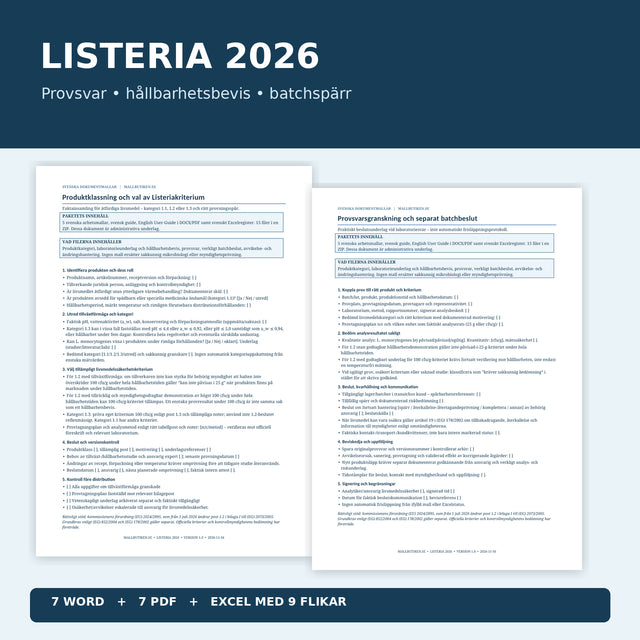
Listeria 2026: 25 g or 100 cfu/g – shelf-life studies and batch decisions
A practical guide to Listeria criteria, shelf-life evidence, laboratory reports and traceable batch decisions for ready-to-eat food producers in Sw...
 Business guides – contracts, HR, AI & compliance
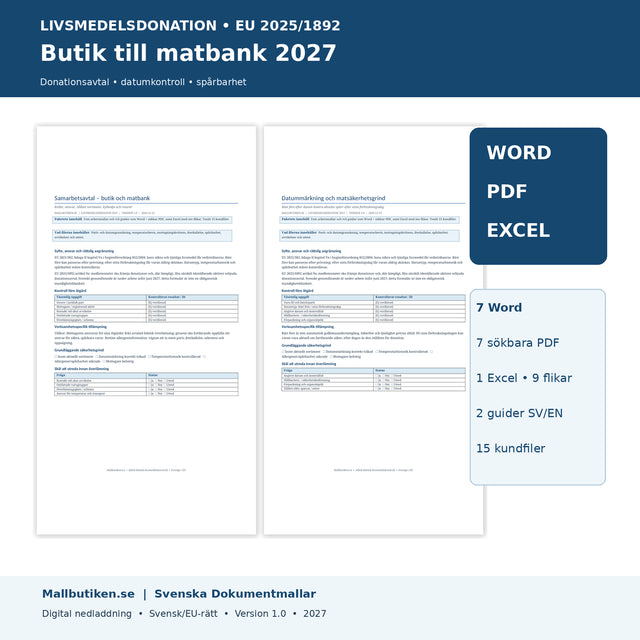
Food donation in Sweden 2027 – dates, cold chain and agreements
A Swedish retailer wants to donate surplus food to a food bank. Safety, date marking, traceability, allergens and cold-chain evidence still matter ...


