
Food donation in Sweden 2027 – dates, cold chain and agreements
A Swedish retailer wants to donate surplus food to a food bank. Safety, date marking, traceability, allergens and cold-chain evidence still matter even when no money changes hands. EU Directive 2025/1892 adds a Member State food-waste prevention framework, not a blanket already-effective duty for every shop to sign a donation agreement.

A Swedish retailer wants to donate surplus food to a food bank. Safety, date marking, traceability, allergens and cold-chain evidence still matter even when no money changes hands. EU Directive 2025/1892 adds a Member State food-waste prevention framework, not a blanket already-effective duty for every shop to sign a donation agreement.
Legal background reviewed 17 November 2026. General information only, not a safety test or government approval.
May a retailer donate food today?
Yes. Food redistribution is already allowed under applicable EU hygiene law when the food is safe and the business verifies the relevant conditions. Commission Regulation 2021/382 inserted Chapter Va into Regulation 852/2004 Annex II, covering the safety assessment of donated foods. The food bank and donor each need suitable procedures for the stages they control. A free transfer is not exempt from food safety obligations.
Best-before is not a use-by date
Products past a best-before date can potentially be donated if the food business has established that they remain safe and fit, including storage and packaging assessment. A product must not be donated after its use-by date. On the stated use-by day it may still be eligible if safe and there is enough time for safe onward use. A normal smell is not proof that a food past use-by is safe. Log the exact date type rather than using a single generic expiry field.
Temperature, packaging and higher-risk foods
Chapter Va asks operators to consider storage and transport conditions, temperature, package integrity, remaining shelf life and food fitness. Use product-specific limits, not a made-up universal refrigeration threshold. Chilled ready-to-eat items with long shelf lives may present listeria risks that cannot be ruled out through a quick smell test. Missing cold-chain evidence or unsafe packaging can require holding or rejecting the donation.
Allergens, information and traceability
Ensure the receiving organisation has enough accurate food information, including allergens where required, to pass on to consumers. Food businesses must be able to identify upstream suppliers and downstream food-business recipients under Article 18 of Regulation 178/2002; donated products are included. Record names, delivery times, product identifiers, batch or lot details where available and recall contacts. The recipient's status as a food business affects the precise traceability duty.
Customer returns and recall readiness
The Swedish Food Agency explains that food returned by end consumers cannot be donated or redistributed because it has left the controlled food-business chain. Business-to-business returns require a separate safety assessment. Establish who may quarantine a batch, warn the next recipient and coordinate withdrawal or recall. A signature alone does not prove safe handling.
What does Directive (EU) 2025/1892 change?
The amended Waste Framework Directive asks Member States to promote food donations and, where appropriate, ensure that certain significant operators identified by the State propose agreements to food banks. The transposition deadline is 17 June 2027. It does not by itself mean every Swedish food shop has a direct present-day legal duty to donate. National 2030 food-waste reduction targets apply to Member States, not as automatic percentage quotas for each shop.
The Swedish proposal published in November 2026
A joint Swedish agency report dated 12 November 2026 proposes national measures and regulatory texts. Section 6.6 favours continuing to encourage donation and providing clearer public information. The draft Swedish ordinance is still labelled 2027:000 and is not a final adopted law. Monitor subsequent legislative decisions before describing a specific Swedish obligation as enacted.
Donation agreement and operational checklist
An agreement can allocate practical tasks: permitted food groups, product-specific temperatures, pickup, receiving checks, date rules, allergen information, records, contact persons and corrective action. It cannot contract out of mandatory safety law. The checklist should capture the donor and recipient, product and batch, date category, actual temperature evidence, packaging, safety decision, dispatch and receipt and any refusal or recall.
Two examples and FAQs
A sealed dry food past best-before may be donated after a documented safety assessment. A chilled ready-to-eat item beyond use-by must not be donated. Is every retailer legally required to sign an agreement in Sweden in 2026? No. Can a spreadsheet certify the cold chain? No, only recorded real checks can support assessment. Does a food bank receiving free products need traceability? Organised recipients operating as food businesses generally do.
Related food-safety guidance
- Listeria in chilled ready-to-eat foods and batch decisions
- Allergen incidents: traceability and corrective action
Primary law and agency guidance
- Direktiv (EU) 2025/1892 – ändring av avfallsdirektivet, artikel 9a
- Naturvårdsverket m.fl. – Förslag till svenskt genomförande, 12 november 2026 (myndighetsförslag)
- Kommissionens förordning (EU) 2021/382 – livsmedelsdonation i kapitel Va
- Livsmedelsverket – livsmedelsdonationer, Kontrollwiki
- Livsmedelsverket – datummärkning, Kontrollwiki
- Livsmedelsverket – spårbarhet för livsmedel
- EU-kommissionen – Food donation, safety and redistribution rules
Donating after a power outage: check food safety before transfer
A grocery store affected by a power failure cannot use donation as a way around cold-chain assessment. Affected chilled or frozen batches may need to be placed on hold until competent staff have documented time, product temperatures, labels and risks. Potentially unsafe food must not be distributed free of charge. Read the separate guide on power outages in food stores, product holds, temperature records and disposal. Assess the batch before any sale or donation.
Explore the topic
 Business guides – contracts, HR, AI & compliance
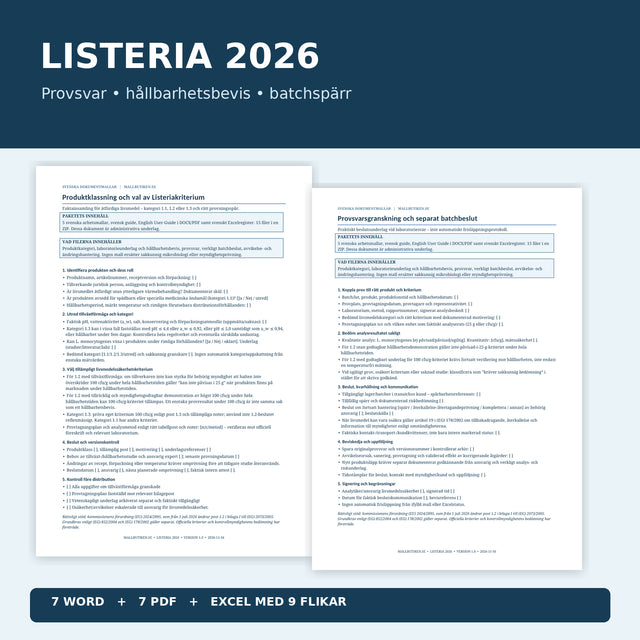
Listeria 2026: 25 g or 100 cfu/g – shelf-life studies and batch decisions
A practical guide to Listeria criteria, shelf-life evidence, laboratory reports and traceable batch decisions for ready-to-eat food producers in Sw...
 Business guides – contracts, HR, AI & compliance
Restaurant allergen incident: reporting and response
Has a guest received incorrect allergen information or reported possible cross-contact? Protect the guest, secure the facts, assess the affected fo...
 Business guides – contracts, HR, AI & compliance
Selling fish online in Sweden 2026 – species, area and fishing gear
An online seafood retailer needs more than a product photograph. Under EU Regulation 1379/2013 Article 35, covered fishery and aquaculture products...


