
Right to Repair 2026/2027 – what applies in the EU and Sweden?

Short answer: EU Directive (EU) 2024/1799 aims to make repairing certain goods easier and more attractive. It includes, among other things, repair requirements for specific product categories and rules regarding repair information. In Sweden, there is an implementation proposal in SOU 2025:124, but as of October 7, 2026, it should still be described as a proposed Swedish implementation rather than final enacted legislation.
What does the EU's Right to Repair entail?
The directive complements existing consumer law rules. Manufacturers of products covered by specific EU reparability requirements must, under certain conditions, offer repairs upon the consumer's request. The directive also includes a European repair information form and rules for a European repair platform.
Which products are affected?
The obligation is not general for all goods. It is linked to product categories covered by EU legal acts with concrete reparability requirements, such as certain household appliances and electronics. The list may be expanded over time.
What was proposed in Sweden?
| Proposal in SOU 2025:124 | Meaning |
|---|---|
| New Repair Act | Manufacturers must, upon request, repair certain consumer goods when repair is possible. |
| Reasonable price | Repairs shall be carried out free of charge or at a reasonable price depending on the situation. |
| Information | Information about the repair service must be easily accessible, clear, and understandable. |
| Repair form | Traders must be able to use a European form with comparable repair information. |
| Extended seller liability | The inquiry proposes a longer claim/liability period when the consumer chooses repair in certain cases. |
What should companies do now?
- Identify which products are covered by the EU's reparability requirements.
- Document spare parts availability, repair channels, and support times.
- Review terms that may hinder third-party repairs.
- Plan for consumer information and internal handling of repair requests.
- Follow the Swedish legislative process before finalizing procedures.
Frequently asked questions
Must all products be repairable?
No. The directive is based on certain product categories being covered by specific EU reparability requirements.
Has the Swedish law been decided?
There is a detailed inquiry proposal. Always check if a government bill and parliamentary decision have been added after the update date of this guide.
Can the manufacturer charge a fee?
The EU rules allow for repairs at a reasonable price in relevant cases. The exact terms depend on the situation and implementation.
See Right to Repair 2026/2027.
Related guides
More working materials: See more templates for EU compliance and product regulations.
Sources
The guide provides general information. Swedish implementation may change during the ongoing legislative process.
Related document templates
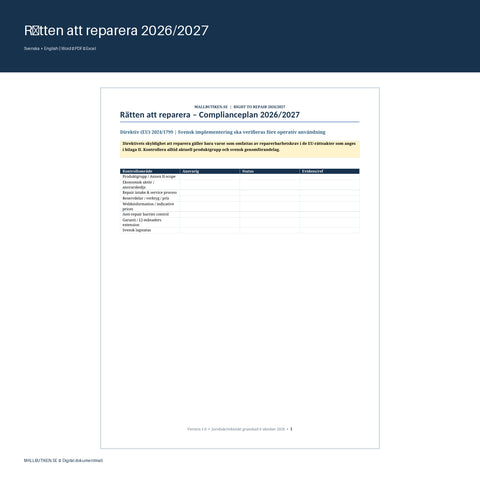
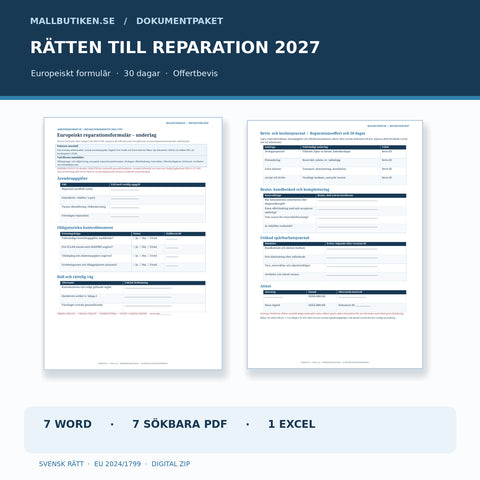
For editable documents, see European Repair Form 2027 – 30-Day Quote, Spare Parts and Repair Receipt | Word/PDF/Excel. Read the product details before use.
Related guide
Read also Repair clause 2026 – which spare parts qualify under EU design Article 22?. Consumer repair rights and the EU design-law repair clause for spare parts are separate legal issues.
Related in-depth guide
Read also Owner consent for smartphone repair – serialised parts and pairing tools. Owner approval for certain software tools used with serial-number-linked phone parts is a separate question from consumer repair rights. Requirements depend on the device and circumstances.
Templates in this article
Explore the topic
 Business guides – contracts, HR, AI & compliance
Environmental claims and greenwashing 2026 – what are companies allowed to say?
Guide to environmental claims and greenwashing 2026: Swedish Marketing Act, EU 2024/825, burden of proof, climate neutrality, net zero, sustainabil...
 Business guides – contracts, HR, AI & compliance
Digital Product Passport (DPP) – what is it and when does it become a requirement?
What is a digital product passport and when does it become mandatory? A guide to the ESPR, the DPP registry, product data, delegated acts, supplier...
 Business guides – contracts, HR, AI & compliance
EU compliance for businesses 2026/2027 – guide to new EU regulations
Pillar guide to EU compliance 2026/2027: PPWR, ESPR/DPP, battery passport, CBAM, EUDR, greenwashing, Data Act, NIS2, and how companies can build a ...


