
TIA and SCCs under GDPR – how to proceed with international data transfers

Short answer: A transfer of personal data outside the EU/EEA requires the organization to first identify whether a third-country transfer is actually taking place and then select a valid transfer mechanism. If no adequacy decision exists, the EU Commission's Standard Contractual Clauses (SCCs) are often used. For SCC-based transfers, the parties need to assess whether the protection is effective in practice—often documented in a Transfer Impact Assessment (TIA)—and, if necessary, implement supplementary measures.
- GDPR Chapter V applies to transfers of personal data to a third country or international organization.
- An adequacy decision under Article 45 is usually the simplest basis when the recipient is covered.
- SCCs under Article 46 are a common tool when an adequacy decision is missing.
- SCCs do not automatically resolve all Schrems II issues; the protection in the recipient country must be assessed in practice.
- Technical, organizational, and contractual supplementary protection may be needed.
When does a third-country transfer occur?
A transfer can occur when personal data is made available to a recipient outside the EU/EEA. This can happen, for example, through cloud services, support access, international corporate systems, sub-processors, or remote administration. Companies should therefore map actual access and data flows—not just where the main supplier has its headquarters.
What transfer bases are available?
| Mechanism | When used | What needs to be checked |
|---|---|---|
| Adequacy decision, Article 45 | The EU Commission has assessed that the country/framework provides adequate protection | That the recipient is actually covered by the decision |
| SCCs, Article 46 | Common contractual mechanism without an adequacy decision | Correct module, annexes, TIA, and any supplementary measures |
| BCR | International corporate groups | Approval and actual application |
| Article 49 derogations | Specific situations | Must be interpreted restrictively and is not a normal solution for regular transfers |
What is a Transfer Impact Assessment (TIA)?
A TIA is a documented assessment of whether the transfer tool, for example SCCs, can provide effectively equivalent protection in practice for the specific transfer. The EU Commission's SCC Q&A explains how Clause 14 requires an assessment of the circumstances of the transfer and the relevant laws and practices in the recipient country.
A TIA should therefore not be a general country report reused without changes. It needs to be linked to the specific data, the recipient, the processing, the transfer chain, government access, and the protection measures actually in use.
What should a TIA at a minimum map out?
- Data exporter, data importer, and any onward recipients,
- Categories of personal data and data subjects,
- Purpose, storage period, format, and sensitivity,
- Relevant laws and practices of the recipient country,
- Potential government access,
- Technical and organizational protections, e.g., strong encryption,
- Whether SCCs can be complied with in practice,
- Conclusion, measures, and date for the next review.
How are Standard Contractual Clauses (SCCs) used?
The EU Commission's modernized SCCs from 2021 contain four modules for different role combinations: controller-to-controller, controller-to-processor, processor-to-processor, and processor-to-controller. The correct module must be selected and the annexes completed concretely.
EU–U.S. Data Privacy Framework
For transfers to the U.S., the adequacy decision for the EU–U.S. Data Privacy Framework can be used when the receiving organization is actually covered by the framework. The IMY states that such a transfer does not need to be supplemented with SCCs or Schrems II measures in the same way as an Article 46 transfer.
If the recipient in the U.S. is not covered by the DPF, the company needs to assess another transfer basis, such as SCCs, and then the question of effective protection and any supplementary measures arises again.
Third-country transfer step-by-step
- Map transfers. Systems, countries, recipients, support access, and sub-processors.
- Determine GDPR roles. Controller, processor, joint controller, or other relevant relationship.
- Check adequacy. Is there an adequacy decision and is the recipient covered?
- Select transfer tool. SCCs, BCRs, or another valid mechanism.
- Perform TIA if necessary. Assess whether the protection works in practice.
- Implement supplementary protections. Document technical, organizational, and contractual measures.
- Check transparency and RoPA. Update privacy notices, records, and supplier documentation.
- Monitor changes. Countries, suppliers, sub-processors, and the legal landscape may change. --
Common mistakes
Signing the clauses without assessing whether the protection works in practice.
The company misses remote access or support from a third country.
Roles are not mapped before selecting the contract.
The assessment describes the country but not the actual transfer.
Frequently asked questions about TIA and SCC
Must all third-country transfers have a TIA?
No. The need depends on the transfer basis. In the case of an adequacy decision, the EU Commission has already performed the protection level assessment. A TIA is primarily central when Article 46 tools like SCCs are used and effectiveness needs to be assessed.
Can SCCs be used with American suppliers?
Yes, in the right situation. If the recipient is not covered by the DPF, SCCs may be relevant, but then the transfer needs to be assessed according to SCC and Schrems II principles.
Do we need a separate data processing agreement with SCC module 2?
The Commission's SCCs integrate the Article 28 requirements into the relevant processor modules. However, verify the entire processing relationship, local contractual requirements, and any other processing activities.
Document TIA, SCCs, and transfer governance
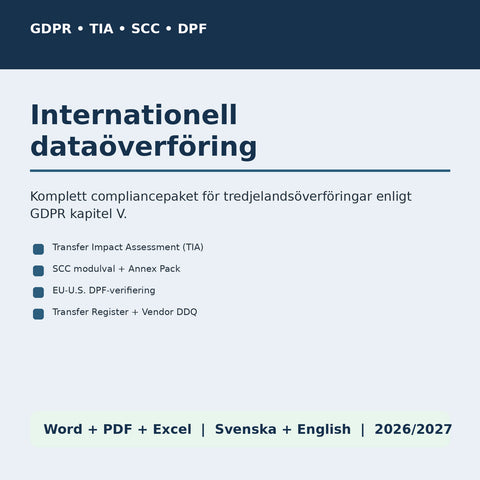
Mallbutiken's international data transfer package contains Swedish and English templates for TIAs, SCC checks, DPF verification, supplementary measures, supplier audits, and an Excel-based transfer register.
See International Data Transfer GDPR & TIA/SCC 2026/2027Related guides
- Controller vs. Processor – what is the difference?
- Data Processing Agreement – when is it needed and what should be included?
- Record of Processing Activities under GDPR Article 30 – how to build a RoPA
Sources
- IMY – Transfer of personal data to third countries
- IMY – Appropriate safeguards
- EU Commission – Standard Contractual Clauses
- EDPB Recommendations 01/2020 – supplementary measures
Templates in this article
Explore the topic
 Business guides – contracts, HR, AI & compliance
Data controller or data processor – what is the difference?
Understand the difference between a controller and a processor under the GDPR, how the roles are determined in practice, and when a data processing...
 Business guides – contracts, HR, AI & compliance
Data Processing Agreement – when is it needed and what should it include?
Determine whether a supplier is a data processor and what the data processing agreement needs to regulate. Practical examples, appendices, and chec...
 Business guides – contracts, HR, AI & compliance
Record of Processing Activities under GDPR Article 30 – how to build a RoPA
Guide to the Record of Processing Activities (RoPA) under GDPR Article 30: content, responsibilities, exemptions, and how the record is used in pra...


