Svenska Dokumentmallar
Invasive Plants 2026 – National Species List, Biosecurity and Contractor Logbook | Word/PDF/Excel
Invasive Plants 2026 – National Species List, Biosecurity and Contractor Logbook | Word/PDF/Excel
- File format
- DOCX, PDF, XLSX
- Document language
- Five Swedish work templates Swedish user guide and English User Guide; Excel in Swedish
- Number of files
- 7
Digital download. No physical product is shipped.
Couldn't load pickup availability
About this template
Spotted knapweed, Japanese knotweed, Canadian goldenrod, giant hogweed or parkslide on your property? From 15 May 2026, a new Swedish ordinance on invasive alien species applies. This practical template package helps property owners, housing cooperatives, associations, municipalities and landscaping contractors document species status, the right to take action on the land, the risk of spread, contractor instructions and waste transfer.
The correct legal distinction is crucial: EU-listed species, such as giant hogweed and giant hogweed, are covered by EU Regulation 1143/2014. For nationally listed species, such as spotted knapweed and Japanese knotweed, there are specific Swedish rules. According to Chapter 3, Section 5 of the ordinance (2026:311), private property owners and rights holders are exempt from the prohibition on intentionally allowing such already present nationally listed species to grow or reproduce, but must – when they have the right to do so – take the necessary measures to prevent spread from the property. Planting, selling or actively spreading nationally listed plants is not permitted under the exemption.
Package contents
15 customer files: five Swedish work templates, a Swedish user guide and an English User Guide in both Word/DOCX and searchable PDF (7 + 7 files). Also a Swedish Excel register with nine tabs (1 XLSX). The package contains eight different documents/tools – Word and PDF are corresponding versions of the same seven documents. Digital ZIP delivery.
What the files contain
Species identification and official listing status, private or public control, species-specific exemptions, stock map, pathways of spread, work orders for contractors, handling of soil and plant parts, transport assessment, waste receipts and follow-up inspection. Excel can display completion flags but does not identify plants, does not permit transport and does not make legal decisions.
The documents – what is each file used for?
| Document | Practical function |
|---|---|
| 01. Species classification and control | Identify the species, current EU/national listing, who has control, any exemptions and manual decision. |
| 02. Occurrence inventory | Document stock, property boundary, photos, area, machinery work and possible pathways of spread. |
| 03. Spread prevention and action plan | Decide how spread is prevented and who is responsible for method, safety, waste assessment and the next inspection. |
| 04. Contractor instructions | Work order before ground work, transport, soil handling and reporting unexpected species findings. |
| 05. Waste certificate and follow-up inspection | Record receipt, recipient, quantity, legal transport assessment, deviation and next follow-up. |
| 06. Swedish user guide | Workflow, clear legal differences, practical examples, species-specific control questions and official sources. |
| 07. English User Guide | English reading instructions, legal terminology and final checklist – the work templates remain Swedish. |
| 08. Excel register | Nine Swedish tabs with registers for properties, stock, actions, contracts, waste and follow-up. |
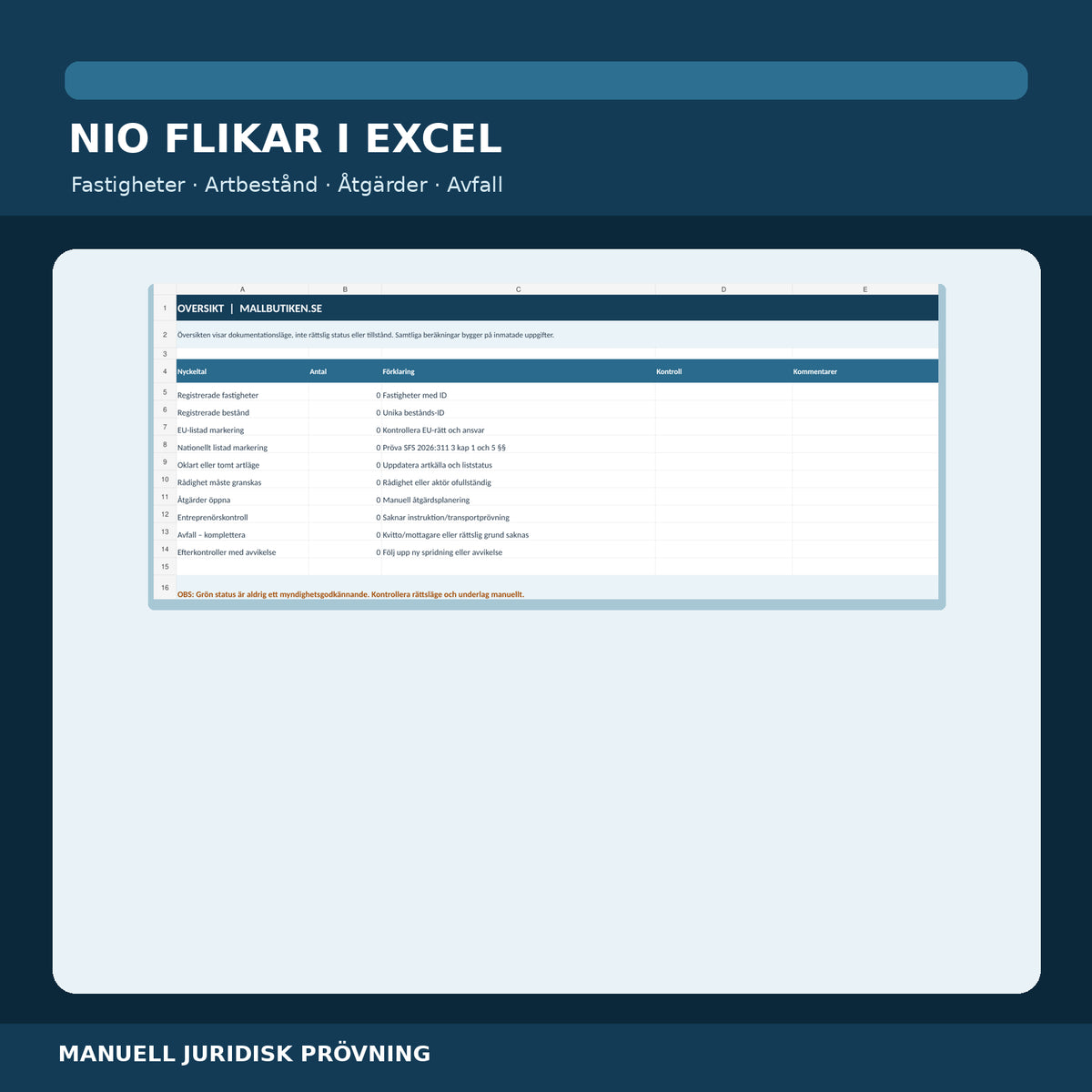
Excel – nine tabs for traceable documentation
Las mig, Oversikt, Fastigheter, Artbestand, Atgarder, Entreprenader, Avfall, Uppfoljning, Kallor. The formulas provide signals such as “SPECIES STATUS MISSING”, “CONTROL CONTROL”, “EU – MANUAL ASSESSMENT”, “SPREAD PREVENTION / PRIVATE”, “COMPLETE” and “NEW SPREAD – FOLLOW UP”. These are administrative control flags, not permits or certificates of lawful waste management. The nine tabs have been tested with ten separate scenario checks. No fictitious test cases are included in the customer file.
Example: why is separate species and responsibility control required?
Private housing cooperative with spotted knapweed: The board documents that the species is on the national list, who has the right to take action on the land and how spread from the property is prevented. The national private exemption rule is not a general exemption from the spread prohibition.
Giant hogweed on the plot: An EU-listed species must be assessed according to EU regulation and any management measures. The Swedish private exemption provision for nationally listed species does not apply generally.
Spotted knapweed or Japanese knotweed: The ordinance contains specific exemptions. For spotted knapweed, parts of the prohibitions only apply in Kalmar and Gotland counties, while certain Japanese knotweeds on older vegetation roofs and sterile vresrose hybrids may be covered by special conditions. Document evidence before assuming that an exemption applies.
Workflow in six steps
- Confirm the species name and check the current EU or national listing with date and source reference.
- Establish the property boundaries, owner, any rights of use and who has the right to carry out the actions.
- Inventory the stock and plan species-specific spread prevention with a competent assessment of risks.
- Provide written work instructions to the contractor before ground work or soil handling.
- Verify that the planned transport and recipient handle the current plant material in an approved manner, and keep receipts.
- Perform and record follow-up inspections. Conclude only after a documented manual decision.
Frequently asked questions
Do I have to dig up all spotted knapweed growing on a private plot?
Not generally just because the species is on the national list. For private owners/rights holders, there is a special exemption from the prohibition on allowing the species to grow or reproduce. Necessary measures to prevent spread outside the property may still be required. An assessment of the actual case is required.
Does the same exemption apply to parkslide?
No. Parkslide is on the EU list according to the Swedish Environmental Protection Agency's current list and must be assessed according to EU rules. Listing status and current management measures must always be re-verified.
Can the contractor drive away the plant waste to a regular compost?
Not without control. Stored plant matter, seeds, roots, transport and reception may involve spread risk and regulated procedures. Document the legal basis and the recipient's actual acceptance.
Does Excel automatically determine which species is EU-listed?
No. The user must themselves enter the verified status and source. The formulas only show which basis needs to be completed.
Can we use this as a municipal authority notification?
No. The templates are internal documents and replace neither authority decisions, regulations nor requirements for professional species identification.
Are all 15 files in Swedish?
Five work templates, one Swedish guide and Excel are in Swedish. A separate English User Guide provides instructions for English-speaking users. Each Word document is also available as a searchable PDF.
Legal sources and transparency
The ordinance (2026:311) on invasive alien species, especially Chapter 3, Sections 1 and 5–8, came into force on 15 May 2026 and replaced ordinance (2018:1939). See also EU Regulation 1143/2014, the Swedish Environmental Protection Agency's national listing and EU-listed species in Sweden.
Version 1.0 – 19 November 2026. The legal information has been source-checked with AI assistance against public sources; no independent lawyer, botanist, environmental consultant or authority has reviewed or approved the product. Check updated regulations, species lists and species-specific management programs. The documents do not replace permits, actual risk assessment, consultant inspection or contact with the authority.
Related product range: Material inventory before demolition and Hazardous waste – waste journal have other uses. This product specifically concerns invasive plants and spread prevention.