Svenska Dokumentmallar
Task details for BAS-U – contractor’s start of work, coordination and clearance | Word/PDF/Excel
Task details for BAS-U – contractor’s start of work, coordination and clearance | Word/PDF/Excel
- File format
- DOCX, PDF, XLSX
- Document language
- Five Swedish work templates and a Swedish user guide in DOCX/PDF a separate English User Guide in DOCX/PDF (main documents not translated) Swedish XLSX with 9 tabs.
- Number of files
- 7
Digital download. No physical product is shipped.
Couldn't load pickup availability
About this template
Does a contractor need to provide risk information to the client before work begins? This Swedish document package helps contractors and clients document risk information, coordination between companies, requests for additional information, and an actual clearance. The package does not replace a risk assessment, occupational health and safety plan, or the client's actual safety review.
Quick facts: Sweden, AFS 2023:3 and AFS 2023:13. Five Swedish work templates, a Swedish user guide, and a separate English User Guide. Seven editable DOCX files, seven matching searchable and printable PDFs, and a Swedish Excel workbook (XLSX) with nine tabs – a total of 15 customer files. The PDFs lack interactive fillable fields. Software that opens DOCX/PDF/XLSX is required. Future delivery after manual activation: digital ZIP.
01. Package contents
Seven independent documents – five operational Swedish templates, a Swedish guide, and an English instruction guide – in DOCX and PDF formats. Plus an XLSX with nine tabs. 7 DOCX + 7 PDF + 1 XLSX = 15 customer files. The English guide is not a translation of the five main documents.
02. What the files contain
Contractor and work-phase information, three risk categories, coordination and protective measures, special risks, missing documentation, requested additional information, an actual communicated client decision, action responsibilities, and evidence references. The status fields distinguish submitted, received, reviewed, and approved decisions.
Who should choose the template – and who should not?
Situation 1: A subcontractor is about to start installing equipment while lifting and transport operations are taking place on the site. The contractor needs to report risks to others and how they are to be coordinated. Situation 2: The client lacks risk documentation and requests additional information before the contractor's first start can be permitted.
Choose another document to establish the complete occupational health and safety plan, document the transfer of responsibility from the client's project manager to the client, or conduct an independent safety assessment of dangerous work. These documents are not interchangeable.
File by file – exact content and format
| File / document | Use | Language | Format |
|---|---|---|---|
| 1. Risk information for the client | The contractor's three risk categories, work phases, and preventive measures | Swedish | DOCX + PDF |
| 2. Coordination and interface sheet | Simultaneous contractors, risks to others, responsibilities, and coordination needs | Swedish | DOCX + PDF |
| 3. Special risks – occupational health and safety plan basis | Risk information for the client's review of the occupational health and safety plan, not an automatic plan change | Swedish | DOCX + PDF |
| 4. Request for additional information and receipt | Missing information, request, actual receipt, and next check | Swedish | DOCX + PDF |
| 5. Client clearance – decision protocol | Separate document for an actually communicated decision or no clearance | Swedish | DOCX + PDF |
| 6. Swedish user guide | Workflow, fields, legal limitations, and final checklist | Swedish | DOCX + PDF |
| 7. English User Guide | Instructions for using the Swedish forms under Swedish rules | English | DOCX + PDF |
| 8. Client risk register – nine tabs | Risk information, special risks, coordination, documentation, measures, decisions, and evidence | Swedish | XLSX |
The Excel tool in practice
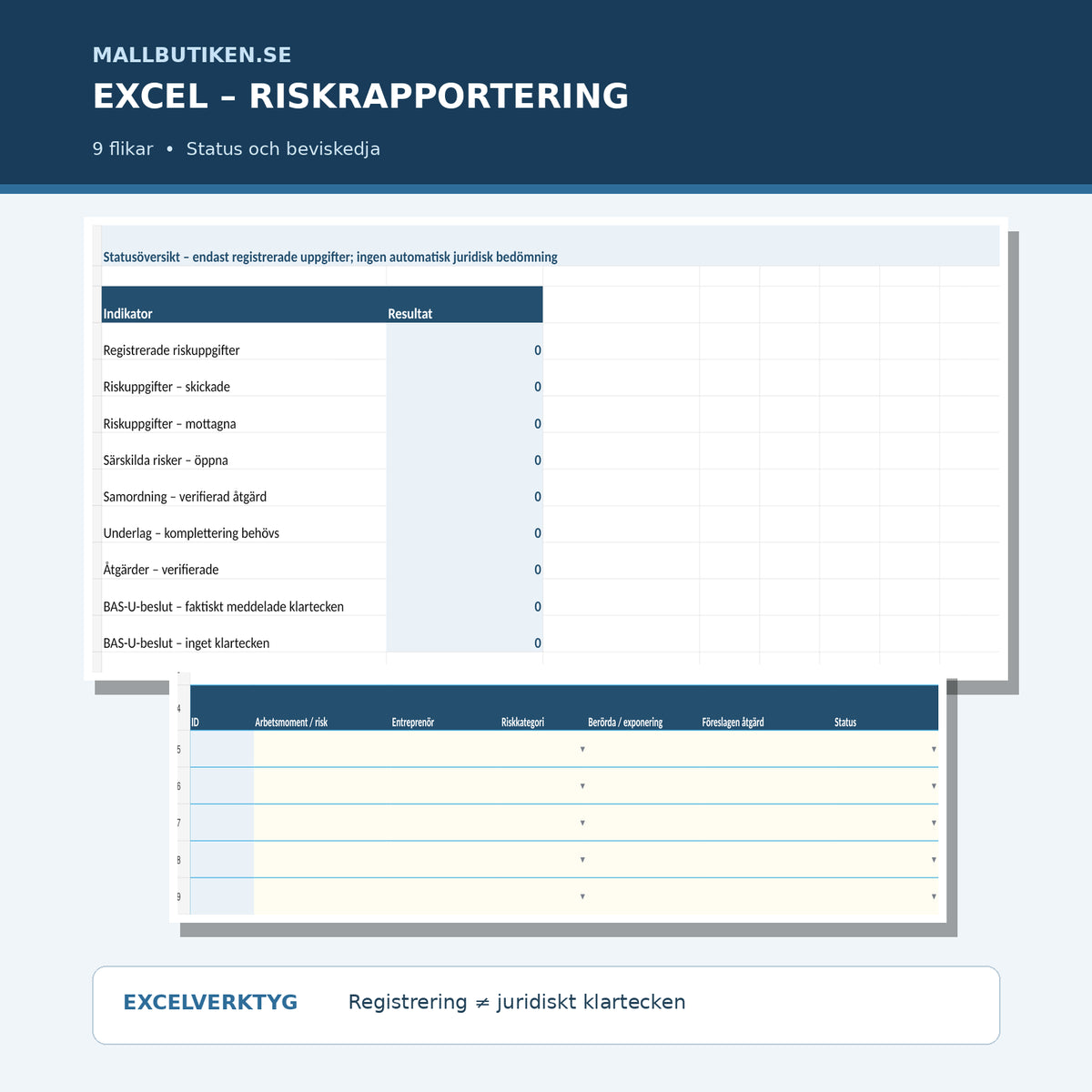
Nine tabs: Overview, Risk information, Special risks, Coordination, Documentation, Measures, Client decision, Evidence index, Read me. Register with ID, filtering, selectable statuses, and nine summary counters. Test case: a risk information entry can be marked as sent while the client decision is still No clearance. Excel does not make legal or safety decisions and does not grant permission to start work.
How the templates are used
- Identify the contractor, construction project, client, and first work phase.
- Describe special risks, risks to others, and own risks that need to be coordinated.
- Attach actual risk assessments and planned measures; check simultaneous work phases.
- Submit the information to the client and document receipt and any requests for additional information.
- The client conducts an actual review and issues a clearance decision; document only an actually communicated decision.
- Inform those affected, manage new risks, check protective measures, and archive the correct documentation.
Legal basis and limitations
AFS 2023:3, Chapter 4, Sections 12–13: The client shall give clearance before the contractor's first start of work after an exchange of risk information and shall request missing information. See the Swedish Work Environment Authority regulation. AFS 2023:13, Chapter 5, Section 5: employers shall provide information on special risks, risks to others, and own risks that need to be coordinated; see the official regulation.
Important caveats: This is not an official government form. Risk classification, signing, and receipt do not guarantee that a protective measure works. Clearance may be communicated orally in accordance with general guidance, and this written template does not replace actual communication. For special risks, a competent occupational health and safety assessment and applicable safety requirements must be carried out separately.
Choose between related documents
An occupational health and safety plan governs the project's preventive occupational health and safety work. The client's project manager to client transfer applies to the transfer from planning to production. This package concerns the contractor's own risk reporting to the client before the first start of work, as well as the documented request for additional information and decision flow.
Frequently asked questions
Does a contractor need to provide risk information to the client?
Yes, relevant information on special risks, risks to others, and own risks that need to be coordinated must be provided in accordance with AFS 2023:13, Chapter 5, Section 5. The risks must be described specifically for the project.
Does a received form mean that work can start?
No. The client's actual clearance before the first start of work is separate from whether information has been sent or received. The risks must be managed or measures planned in accordance with AFS 2023:3, Chapter 4, Section 12.
Can clearance be given orally?
Yes. General guidance allows for an oral decision. Written documentation is a possible supporting evidence, not the only legal way to communicate clearance.
Does it include a complete occupational health and safety plan?
No. The template contains risk documentation for the client's review but does not replace the occupational health and safety plan or the employer's special risk assessment.
Are the PDF files digitally fillable?
No. They are searchable and printable without interactive form fields. Editable DOCX files are included.
Are the main templates in English?
No. The work templates and Excel are in Swedish. Only the separate English User Guide is in English.
Related resources
- Occupational health and safety plan – construction and civil engineering
- Client's project manager to client – transfer protocol
- Occupational health and safety and construction safety templates
Sources, version, and openness
Version 1.0, November 18, 2026. AI-assisted source review on November 18, 2026. No documented independent external legal review or government approval.