About this template
Forklift authorization and risk assessment for safe forklift operations – Word, PDF and Excel
Does the employer need to document written driving permits for forklift operators, risk assessments for forklift traffic in warehouses, or a safe traffic plan? This package gathers the separate documents needed for a structured and traceable process: identifying actual collision risks, separating traffic routes from pedestrians, checking training records, deciding on personal permits, and following up on incidents and non-conformities.
15 files in one ZIP: seven editable Word (DOCX) files, seven corresponding searchable A4-PDFs, and one functional Excel workbook (XLSX) with nine tabs. Five main Swedish templates, one Swedish user guide, and an English User Guide. The 2026/2027 year designation refers to the document edition, not a guarantee of future regulatory changes.
01. Package contents
- 7 Word files (DOCX) – five Swedish work templates, a Swedish guide, and an English User Guide.
- 7 searchable PDF files – corresponding documents in A4 for printing and archiving.
- 1 Excel workbook (XLSX) – nine tabs with filtering, status fields, control references, and a formula-based overview.
Total of 15 files. Language: Swedish main documents and guide, supplementary English User Guide. Version 1.0 – 2026/2027. Delivery: digital ZIP after purchase once the file is linked in Digital Products. All Word and PDF documents have two separate, framed information boxes.
02. What the files contain – file by file
| Document | Use and content | Format |
|---|---|---|
| 01. Risk assessment forklift traffic and warehouse | Site-based inventory of collisions, pedestrian traffic, intersections, loading docks, load securing, and risk severity. | DOCX + PDF |
| 02. Personal written forklift permit | Issuer (employer or host company), operator, forklift types, work tasks, zones, restrictions, and signature. | DOCX + PDF |
| 03. Traffic plan and safety routines | Driving routes, separation of pedestrians, local driving rules, loading zones, visibility, and shared workplaces. | DOCX + PDF |
| 04. Knowledge check and site introduction | Actual documentation of theory, practice, forklift type, local instructions, and the responsible assessor. | DOCX + PDF |
| 05. Inspection, incident, and action log | Performed inspections, near-misses, immediate actions, responsibilities, and verification of results. | DOCX + PDF |
| 06. Swedish User Guide | Ten concrete work steps, sources, common risks, and usage of all files. | DOCX + PDF |
| 07. English User Guide | English instructions for the Swedish templates and Excel; no English main templates included. | DOCX + PDF |
| 08. Excel register – nine tabs | Overview, Risks, Permits, Operators, Inspections, Actions, Incidents, Evidence, and Read me. | XLSX |
All work documents require real data, division of responsibilities, and – where relevant – signatures. No operator permits or risk levels are pre-approved.
When is a written forklift permit required?
According to AFS 2023:11, Ch. 4, sections 16–17, a forklift operator must have documented theoretical and practical knowledge and a personal written permit for forklift use. The permit must specify which forklift types and tasks it covers and must be issued by the employer or, when regulations require it for hired labor, the host company. A forklift license or training certificate does not replace a written driving permit. The template file only provides a basis; it becomes a permit only when the correct issuer has made an actual assessment and made a decision.
Risk assessment, driving routes, and pedestrians
AFS 2023:1, section 11, requires written risk assessments and that serious risks are identified. According to AFS 2023:11, Ch. 4, section 8, forklift traffic should be separated from pedestrians and other activities where people are present if possible; otherwise, injury risks must be prevented with special consideration for poor visibility and warning options. Driving routes, speed, loading docks, and measures must be designed according to actual local conditions. Supplement with safety inspection and work environment round templates when a broader work environment review is needed.
The Excel tool: nine tabs with real-world follow-up
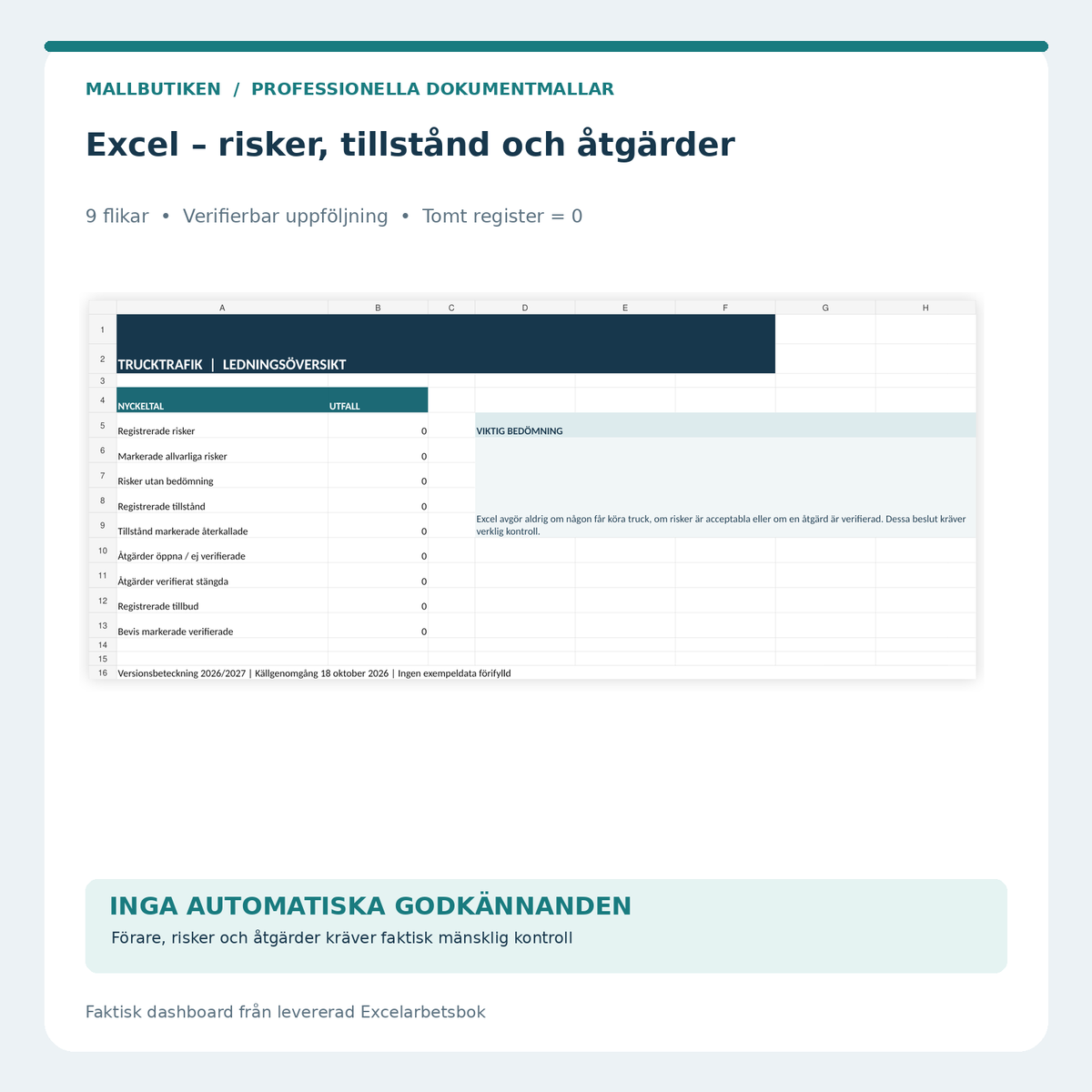
Overview, Risks, Permits, Operators, Inspections, Actions, Incidents, Evidence, and Read me. The file helps to keep track of permit decisions, documented competence checks, identified risks, and actually verified actions. The dashboard calculates, among other things, registered risks, manually flagged serious risks, registered permits, documented incidents, as well as open and verified closed actions.
Important distinction: a value for probability × consequence is indicative internal support and does not replace human judgment regarding whether a risk is serious. A recorded operator is not automatically authorized. An action reported as performed is not verified without a check. Empty tabs show 0, not that the workplace is risk-free.
How to use the file package
- Identify the employer and the host company and clarify who is responsible for the risk assessment and individual permit.
- Examine actual forklift traffic at the workplace: pedestrian paths, intersections, doors, ramps, charging stations, and obstructions to visibility.
- Document risks and severity in file 01 and register responsibilities, deadlines, and evidence references in Excel.
- Design a traffic plan with physical separation where possible, local routines, and safe loading zones.
- Verify the operator's theory and practice as well as site-specific introduction with file 04.
- Issue or deny a personal forklift permit after an actual competence assessment with file 02.
- Carry out inspections and register incidents, deficiencies, and actions with file 05 and Excel.
- Follow up on effectiveness and reassess in the event of changed traffic, new forklifts, incidents, or other relevant changes.
Supplementary Mallbutiken templates
- Lone work – risk assessment and alarm plan for people working without immediate proximity to others.
- Ergonomics – manual handling for lifting and ergonomic strain related to warehouse work.
- Production & Industry – templates and Work Environment & Construction Safety – templates for supplementary routines.
Frequently asked questions
Is a forklift license sufficient to drive a forklift at the workplace?
No. A training certificate is not the personal written permit that the employer or host company must issue according to the regulations.
Must the permit specify specific forklifts?
It must clarify which forklift types and tasks it applies to. Also, specify location restrictions and activity-specific conditions when necessary.
Does a risk assessment need to be done for a new warehouse layout?
Yes, planned changes must be risk-assessed if they could lead to work environment risks. Traffic routes and pedestrian paths are particularly important to investigate during remodeling.
Does Excel automatically approve an operator to drive?
No. Excel only registers documented facts and manually entered decisions. The individual competence check and written permit are done by the responsible issuer.
Are English main templates included?
No. The five main documents are in Swedish. The English User Guide explains how the Swedish templates and the Excel tool are used.
Legal sources and edition
- Swedish Work Environment Authority – AFS 2023:11, Ch. 4 on forklift use.
- Swedish Work Environment Authority – AFS 2023:1 on systematic work environment management.
- Swedish Work Environment Authority – Knowledge and permits for safe forklift use.
- Swedish Work Environment Authority – Prevent forklift accidents.
Source review: October 18, 2026. Document edition: 1.0 – 2026/2027. The template is practical support in accordance with Swedish law; it is not authority-approved, externally lawyer-certified, or a guarantee of regulatory compliance.