
Bankruptcy in limited companies 2026/2027 – step by step from crisis to handover

Short answer: A limited company can be declared bankrupt when it is insolvent – it cannot pay its debts on time and the payment problems are not merely temporary. The board must distinguish this assessment from the question of whether there is a capital deficiency under the Swedish Companies Act. Filing a the company's own bankruptcy petition with the Swedish Courts is free of charge; a purchased document package is merely a tool to help prepare the documents.
1. Create a reliable financial overview
Compile bank accounts, today's cash position, overdue and upcoming debts, accounts receivable, securities, taxes, wages, inventory and important contracts. Note the source, date and the person who checked each piece of information. A 13-week liquidity forecast can show when the money will run out, but a negative calculation is not automatically a legal decision on bankruptcy.
Decisions and facts should be kept separate. Do not retroactively alter the accounting to make a particular forecast look better and do not make selective payments to related parties without first investigating the legal risks.
2. Examine capital deficiency and insolvency separately
Capital deficiency: The Swedish Companies Act's rules on a statutory control balance sheet (kontrollbalansräkning) may apply if there are grounds to believe that the company's equity falls below half of the registered share capital, or in certain fruitless asset distribution situations. Insolvency: Chapter 1, Section 2 of the Bankruptcy Act deals instead with the ability to pay and whether the difficulties are not merely temporary. They can occur at the same time, but do not have to.
Read the in-depth guide insolvency or capital deficiency in limited companies and the existing statutory control balance sheet (kontrollbalansräkning) rules with examples. A statutory control balance sheet (kontrollbalansräkning) is not a general mandatory attachment to a the company's own bankruptcy petition.
3. Explore possible courses of action without wasting time
Liquidity measures, new financing, corporate restructuring, voluntary winding up and bankruptcy have different purposes and conditions. A solvent company can, for example, be wound up through voluntary liquidation, but this is not the same process as bankruptcy due to insolvency. In case of uncertainty, particularly assess the risk of director liability, taxes, accounting offences, personal guarantees and related-party transactions with a qualified advisor.
New opportunity for tax debts 2026: If the company has difficulty paying tax, a director may in certain cases personally apply for a payment moratorium under the Tax Procedure Act. This is not the same as a tax deferral or a general stay of bankruptcy. Read payment moratorium 2026 – application and director liability and check the Swedish Tax Agency's current instructions.
4. Prepare the the company's own bankruptcy petition correctly
Base it on the Swedish Courts' official information and free application. Check the company's registered seat, competent court, signing authority, any powers of attorney and an up-to-date certificate of registration from the Swedish Companies Registration Office. The courts' current instructions state that the certificate of registration must be no more than one month old. Since 1 July 2026, bankruptcies are handled by twelve specially competent district courts; therefore, do not choose a court solely based on geographical proximity.
See the step-by-step guide applying for the company's own bankruptcy in a limited company. Mallbutiken does not provide an official court form and does not charge a court fee.
5. Secure the documentation before and after the decision
Keep accurate accounting records, bank statements, inventory lists, lists of debts, contact details and current contracts. Save what has been submitted, any supplements and receipts. Once the district court has decided on bankruptcy, the directors must not freely sell the bankruptcy estate's property or decide which creditors are to be paid. The bankruptcy trustee is responsible for managing the estate; the directors may need to cooperate by providing facts and documents.
Read more about what happens after the bankruptcy decision and use the checklist for handover to the bankruptcy trustee.
If the company has employees: See our separate guide to personnel in bankruptcy – unpaid wages, holiday pay and wage guarantee to compile the documentation before contacting the bankruptcy trustee.
Taxes and accounting: The director also needs to reconcile VAT, employer declarations, F-tax and records up to the bankruptcy. Read the guide to taxes in bankruptcy for limited companies for a separate checklist.
Which documents are needed in practice?
Internal decision-making documentation may include board minutes, a liquidity forecast, registers of debts and receivables, an overview of assets and contracts, a personnel list, a document log and a handover receipt. Requirements vary between companies. These are working documents, not general statutory bankruptcy attachments.
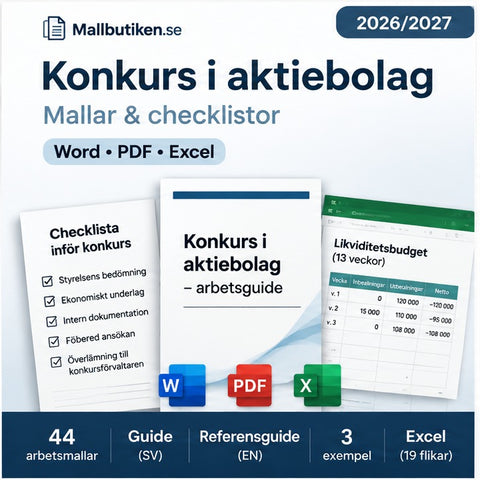
See the document package for bankruptcy in limited companies (Word/PDF/Excel), or compare related templates for insolvency and bankruptcy. The package is sold separately from the Courts' free application.
Frequently asked questions
Is it free to file a the company's own bankruptcy petition?
Yes, the application to the court itself is free of charge. An optional template package from a private provider is voluntary.
Must a statutory control balance sheet (kontrollbalansräkning) be prepared before bankruptcy?
Not as a general formal application requirement. The board must at the same time follow the rules of the Swedish Companies Act when the conditions for a statutory control balance sheet (kontrollbalansräkning) are met.
Who decides that the company is declared bankrupt?
The district court examines the bankruptcy petition and appoints a bankruptcy trustee.
Verified primary sources
- Bankruptcy Act (1987:672), especially Chapter 1, Section 2
- Swedish Companies Act (2005:551), especially Chapter 25, Sections 13–20
- Swedish Courts – the company's own bankruptcy, legal person
- Swedish Courts – new bankruptcy rules from 1 July 2026
Last reviewed against the above sources on 21 November 2026. The information is general, not individual legal advice. In case of risk of personal liability or other complicated issues: contact a qualified advisor.
Templates in this article
Explore the topic
 Business guides – contracts, HR, AI & compliance
Insolvency or capital deficiency in a limited company – what is the difference?
Capital deficiency is based on equity, while insolvency concerns the ability to pay debts. Three practical examples and clear guidance on KBR and b...
 Control balance sheet – guides & guidance
When is a balance sheet for liquidation purposes required? Rules and examples
When is a balance sheet for liquidation purposes required? A guide to the two statutory situations in Chapter 25, Section 13 of the Swedish Compani...
 Business guides – contracts, HR, AI & compliance
Raw data 2026 for limited companies – two months, directors' liability and tax debts
New debt restructuring rules 2026: when a representative can obtain two months, what the protection covers, obstacles, application to the Swedish T...


