
Taxes in the event of bankruptcy of a limited company – VAT, employer contributions, preliminary tax and accounting

Short answer: When a limited company is declared bankrupt, the requirements for correct tax reporting for the period before the bankruptcy decision do not cease. The company's representatives must ensure that the company's information on, among other things, VAT, employer declarations, and income tax can be reported. After the decision, a different allocation of responsibility applies: the bankruptcy trustee represents the bankruptcy estate, and the Swedish Tax Agency handles the company's registrations for F-tax, VAT, and employers. Therefore, always distinguish the company's circumstances before the bankruptcy from the bankruptcy estate's possible continued operations. The Swedish Tax Agency's guidance on closing a limited company is a good starting point.
What happens to taxes when a limited company goes bankrupt?
The day of bankruptcy does not mean that older tax and declaration information disappears. The company's events and accounting periods before the bankruptcy decision need to be reconcilable with the accounting, bank, tax account, and previous declarations. The Swedish Tax Agency is notified of the bankruptcy and normally revokes the F-tax approval and deregisters the VAT and employer registration according to the rules that apply. If the bankruptcy estate continues to operate, its accounting is handled separately.
This is a practical area where the responsible representative, accounting consultant, and bankruptcy trustee should coordinate. The Swedish Tax Agency's general information sometimes simplifies the legal process; therefore, it is important not to assume that every individual form or deadline automatically ceases on the day of bankruptcy.
1. VAT – distinguish between the period before and after the bankruptcy decision
First reconcile the company's VAT reporting for the period up to the bankruptcy: sales, purchases, customer invoices, credit notes, accruals, and any corrections. According to the Swedish Tax Agency's legal guidance, the bankrupt debtor's last VAT declaration should cover relevant circumstances up to the onset of bankruptcy. If the bankruptcy estate subsequently sells goods or services, special VAT rules may apply to the estate. Therefore, staff should not continue to use the debtor company's previous VAT flow without the trustee's instructions.
Working material: period, declaration ID, invoice range, accounting account, VAT amount, previously submitted declaration, any discrepancies, and who is to check the information. Keep the original documents even if later corrections become necessary.
2. Employer declaration (AGI) and staff
If the company has had employees, paid wages, tax deductions, and employer contributions need to be reconciled for relevant periods before the bankruptcy. An incomplete payroll is not the same as a completed declaration basis. Separate wage information that has already been paid from unpaid wage claims. The latter may need to be handled in the bankruptcy proceedings and in a possible wage guarantee review.
In continued operation, the bankruptcy estate may have its own obligations as an employer. Therefore, do not confuse the previous representatives' reporting responsibility with the trustee's responsibility for the estate's arrangements. For staff compensation issues, read staff in bankruptcy: wages, vacation, and wage guarantee.
3. F-tax and debited preliminary tax
The Swedish Tax Agency receives information about the bankruptcy and takes measures regarding the company's F-tax and debited preliminary tax. The company's representatives should save decisions, tax account statements, and any reviews. It is not correct to assume that already due taxes cease to exist just because the F-tax is revoked.
Collect decisions on preliminary tax and check if there are periods with an estimate that no longer corresponds to the actual circumstances. Let a qualified representative or advisor handle any review according to current rules and authority instructions.
Representative responsibility and tax debts: The new rules from 2026 may give a representative personal leeway of two months for certain taxes. It is not a deferral for the company. Read the guide on leeway and tax law representative responsibility for conditions, personal applications, and exceptions.
4. Income declaration and the company's deregistration
A limited company can still be subject to declaration requirements during the liquidation process. The Swedish Tax Agency's guidance states that limited companies should submit income declarations until the company is deregistered. Therefore, check which tax year and which accounting periods are affected in the specific case. The bankruptcy estate and the bankrupt debtor are not the same tax subject for all purposes, and the rules may vary between tax types.
If you are a shareholder, there is a separate private declaration issue: in the bankruptcy of a limited company, the shares may be considered sold for tax purposes. A possible K10 or K12 form applies to the owner's situation and should not be mixed up with the company's VAT or AGI reporting. See Verksamts information on bankruptcy of limited companies and The Swedish Tax Agency's guidance on the company's income declaration.
5. Accounting, verifications, and digital archive
According to the Swedish Accounting Standards Board's guidance, a limited company should have ongoing accounting, verifications, and financial information that is archived in an orderly manner according to the rules of the Accounting Act. Bankruptcy changes who has control over the bankruptcy estate's assets, but it does not mean that existing accounting information may be deleted, manipulated, or left without traceability.
Prepare the general ledger, verification list, SIE export, balance and income reports, bank statements, invoices, agreements, inventory basis, tax account statements, and information about the accounting system administrator. Save the export date and file version. Share access through a secure handover routine; do not put passwords or personal information unencrypted in Excel. Read The Swedish Accounting Standards Board's current accounting rules for limited companies.
Practical checklist – the first steps
- Establish the date: register the day of the bankruptcy decision and define relevant tax periods.
- Collect basis: tax account statements, VAT declarations, employer declarations, preliminary tax decisions, verification lists, and bank account statements.
- Reconcile amounts: distinguish between declared, accounted for, paid, unpaid, and disputed.
- Distinguish responsibility: state which basis the representatives are responsible for and what should be handed over to the bankruptcy trustee.
- Mark uncertainties: list missing invoices, unreported wages, incorrect VAT periods, and any correction needs; do not make up amounts.
- Organize handover: give the trustee a traceable document list and secure access to the accounting system.
- Check personal responsibility: in case of due taxes or other risks, qualified help should be sought immediately; a template cannot provide immunity.
Three examples of when different actions are needed
Example A: Limited company without employees. Prioritize VAT, customer and supplier invoices, bank accounts, the company's income tax, and document handover. No employer declaration should be created solely because the package contains a staff template.
Example B: Company with three employees and unpaid wages. Separate actual previous wage payments/AGI from outstanding wage claims. Use staff basis for the bankruptcy trustee, but do not make your own wage guarantee decisions.
Example C: The bankruptcy estate continues the operation. The bankruptcy trustee needs to make a decision on the estate's registration, VAT, and any employees. The previous board should not continue to invoice as if nothing happened.
Document templates and Excel registers – which parts are relevant?
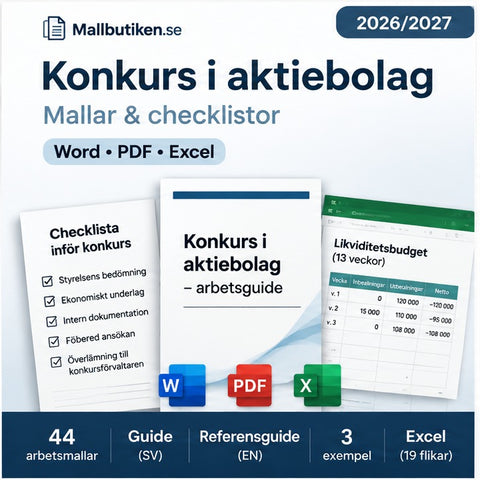
Bankruptcy in limited companies – Word/PDF/Excel document package includes, among other things, a checklist for taxes, AGI, and declarations, an index for accounting documents, registers for bank and tax account information, and an Excel register with separate tabs for taxes, employees, debts, and document handover. The document package is voluntary work support and does not contain the Swedish Tax Agency's official declaration forms as private payment forms.
For the bigger picture, see bankruptcy in limited companies – step by step, handover to bankruptcy trustee, or all bankruptcy and insolvency templates. In case of acute payment difficulties, the company still needs to receive a separate insolvency assessment.
Common questions about taxes in bankruptcy
Do I need to submit a VAT declaration when the company has gone bankrupt?
The reporting for the company's operations up to the bankruptcy must be handled. After that, the bankruptcy estate may have other reporting obligations. Check the correct period and responsible party according to the Swedish Tax Agency's instructions.
What happens to AGI when wages are unpaid?
Separate paid amounts and made tax deductions from the employees' unpaid wage claims. The reporting and possible wage guarantee should be assessed in the correct order.
Is F-tax revoked automatically?
The Swedish Tax Agency receives notification of the bankruptcy and revokes the company's F-tax approval according to applicable rules. Check the actual decision in the company's case.
How long should accounting be saved?
The Swedish Accounting Standards Board states that limited companies' financial information should be archived for seven years according to the provisions of the Accounting Act. Prerequisites for handover and storage should be investigated with the bankruptcy trustee.
Can a board member become responsible for unpaid taxes?
Yes, personal responsibility can arise according to special rules and circumstances. It does not arise automatically for every board member and debt. Seek qualified advice if the situation is relevant.
Controlled sources
- Swedish Tax Agency – close limited company (bankruptcy, taxes, VAT, and AGI)
- Swedish Tax Agency – what happens when a company starts doing worse?
- Swedish Tax Agency – declare for limited company
- Verksamts – bankruptcy of limited company
- Swedish Accounting Standards Board – what applies to limited companies?
- Bankruptcy Act (1987:672)
The sources were checked on November 21, 2026. The information is general and does not provide individual tax decisions or legal advice. Never set your own automatic deadlines or legal effects without checking the applicable rules.
Templates in this article
Explore the topic
 Business guides – contracts, HR, AI & compliance
Employees in the event of a limited company’s bankruptcy – wages, holiday pay and wage guarantee 2026/2027
How employees, unpaid wages, holiday pay and wage guarantees are handled when a limited company goes bankrupt. With checklist, sources and supporti...
 Business guides – contracts, HR, AI & compliance
Raw data 2026 for limited companies – two months, directors' liability and tax debts
New debt restructuring rules 2026: when a representative can obtain two months, what the protection covers, obstacles, application to the Swedish T...
 Business guides – contracts, HR, AI & compliance
Bankruptcy in limited companies 2026/2027 – step by step from crisis to handover
When can a limited company go bankrupt? Insolvency, the solvency test, free bankruptcy petition, district court, administrator and what documents m...


