Svenska Dokumentmallar
Bankruptcy of a limited company 2026/2027 – document package | Word/PDF/Excel
Bankruptcy of a limited company 2026/2027 – document package | Word/PDF/Excel
- File format
- Word/PDF/Excel
- Document language
- Swedish (44 work templates guide 3 examples) English (reference guide)
- Number of files
- 50
Digital download. No physical product is shipped.
Couldn't load pickup availability
About this template
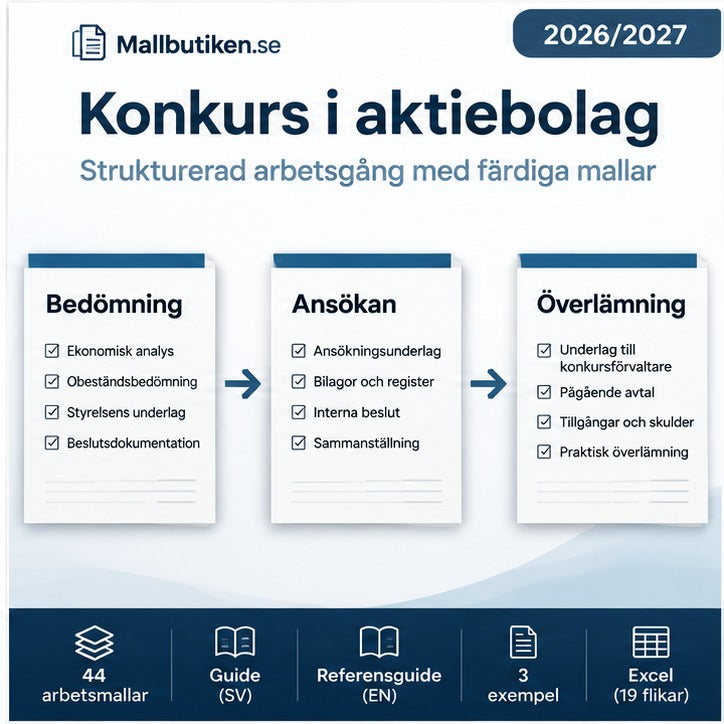
What does a document package for bankruptcy in a limited company contain? This package brings together working templates for the board of a Swedish limited company that needs to understand and document a financial crisis: from the first overdue payments, through a separate assessment of capital deficiency and insolvency, to a possible the company's own bankruptcy application and handover to the bankruptcy trustee. You get editable Word templates, readable PDF equivalents, and an Excel register with 19 worksheets – all available for digital download.
Important note on the number of files: The package contains over 100 technical files because each Word document is also available as a PDF. It does not contain over 100 different legal templates. The core consists of 43 numbered Swedish working templates and a separate glossary/support document – a total of 44 working and support documents – supplemented with guides, examples, and Excel.
Package contents
- 44 Swedish working and support documents: governance, insolvency, control balance, application preparation, handover, personnel, and tax.
- Word and PDF: each Word document has a PDF version for reading and printing.
- Excel register: 19 tabs, including a 13-week liquidity forecast, debts, receivables, assets, employees, and a document log.
- Guides: a Swedish main guide and an English reference guide on Swedish law; an in-depth Swedish file-by-file manual is available in the updated customer package v1.1.
- Three fictional examples: capital deficiency without apparent insolvency, payment difficulties despite assets, and handover after a bankruptcy decision.
- Support files: reading instructions, current authority links, and a control sum list.
What the files help you do
Before the decision: get your tasks, decisions, cash flow, and urgent risks in order. In the event of possible capital deficiency: document a separate control balance track when the conditions of the law apply. In the event of possible the company's own bankruptcy: check the company signature, the correct district court, the registration certificate, and the official form. After the bankruptcy decision: compile accounting, assets, debts, contracts, IT, and personnel for the bankruptcy trustee.
You should not fill out all documents automatically. Choose the right track for the company's actual situation and maintain factual evidence with dates and sources.
How to use the document package – step by step
- Create a situation overview: open folder 01, read the main guide, and compile bank, taxes, overdue debts, salaries, and contracts. Use Word templates 02, 04, and 05, as well as relevant Excel sheets.
- Distinguish between capital deficiency and insolvency: use 03 and 06, as well as the Excel KBR capital/Insolvency indicators. A single figure in Excel does not determine whether the company is legally insolvent.
- Follow the control balance track only where it belongs: if the rules of the limited liability companies act are applicable, use templates 11–18 for supporting documents, notices, minutes, and monitoring.
- Document the decision: note the review of available options in templates 08–09 and seek help on questions regarding director liability.
- Prepare a possible the company's own bankruptcy application: use 19–25 for internal minutes, checklists, and a reception log. The application itself is submitted using the free official form or e-service of the Swedish Courts.
- After the district court decision: use templates 26–37 for the handover of documents and assets to the bankruptcy trustee; the company's former board may not act as the trustee of the bankruptcy estate.
- Handle conditional issues: use templates 38–46 and the corresponding Excel sheets for personnel, payroll data, tax, guarantees, and follow-up in the relevant parts.
Two different legal questions: capital deficiency and insolvency
Capital deficiency may entail obligations under the limited liability companies act, including that the board must immediately prepare a control balance sheet if specific conditions are met. Insolvency under Chapter 1, Section 2 of the Bankruptcy Act means instead that the debtor cannot properly pay their debts and that the inability is not merely temporary. The two questions must be assessed separately.
A control balance sheet is not a general mandatory attachment to a the company's own bankruptcy application. Since July 1, 2026, bankruptcy cases are handled by twelve competent district courts, and several processing tasks have been moved from the courts. Always check where the company is domiciled and the current instructions before submission.
An application for the company's own bankruptcy is free of charge at the Swedish Courts. The price of the template store applies to the voluntary documentation and working support, not the court's form or a government fee.
Complete overview: which 44 working and support documents are available?
Here is the content explained document by document. Each number refers to the actual file names in the delivery folders.
A. Initial situation overview, payment problems, and board decision
Start here when the company shows signs of financial difficulties. You document the facts before any decision is made.
- 02 The first 24–48 hours: prioritizes dates, tax, salaries, liquid funds, and responsible persons.
- 03 Decision tree for capital deficiency and insolvency: keeps the different legal assessments separate.
- 04 Role and responsibility matrix: distributes tasks among the board, CEO, finance, auditors, and representatives.
- 05 Board minutes during a financial crisis: collects meeting details, supporting documents, and actual board decisions.
- 06 Factual assessment of insolvency: lists overdue debts, available funds, and financing options.
- 07 Comments on the 13-week forecast: explains assumptions and uncertainties in the cash flow.
- 08 Action plan for tax, salary, contracts, and risks: collects follow-up responsibilities and actual measures.
- 09 Decision-making memo: helps to document a review of restructuring, liquidation, or bankruptcy.
B. Control balance sheet and control meetings
This is a conditional track under the limited liability companies act – not a mandatory preparation in every bankruptcy case.
- 11 KBR supporting document and adjustment journal: lists balance sheet items and documentation behind any adjustments.
- 12 Board minutes on the control balance sheet: documents the reason, decision, and check of the auditor's question.
- 13 Notice of the first control meeting: provides structure for correct company formalities when such a meeting becomes relevant.
- 14 Minutes from the first control meeting: collects the submitted control balance sheet, voting, and decisions.
- 15 Monitoring plan between control meetings: collects measures, follow-up, and conditional deadlines.
- 16 Notice of the second control meeting: supporting documents for the next meeting if the conditions of the rules are met.
- 17 Minutes from the second control meeting: documents new supporting documents, decisions, and possible capital restoration.
- 18 Special timeline and exception review: separates actual dates from legally controlled deadlines.
C. Preparations for a possible the company's own bankruptcy application
The supporting documents help the company keep decisions and attachments in order. The application itself is obtained free of charge from the Swedish Courts.
- 19 Board minutes on the company's own bankruptcy: documents the board's decision-making basis and position.
- 20 Submission checklist: checks the court, company signature, registration certificate, attachments, and signing.
- 21 Neutral cover letter and attachment list: compiles only the documents that are actually submitted.
- 23 Asset and debt summary: provides a fact-based overview of bank, receivables, inventory, and debts.
- 24 Representative and company signature supporting documents: collects authorization details and limited power of attorney if needed.
- 25 Submission and supplementation log: registers dates, reception, and any supplements.
D. Bankruptcy trustee, assets, and document handover
After a bankruptcy decision, these registers are used primarily for information and traceable handover. They do not give the former board the right to manage the bankruptcy estate.
- 26 First contact with the bankruptcy trustee: checklist for initial tasks, contacts, and practical access.
- 27 Handover protocol: acknowledges documents, keys, systems, and other handed-over material.
- 28 Accounting material – handover index: collects the general ledger, vouchers, SIE/export, bank, and year-end accounts.
- 29 Inventories, inventory, and third-party property: lists holdings, serial numbers, and any ownership claims.
- 30 Bank, cash, and payment services: shows accounts, actual balances, and ongoing payment flows.
- 31 Debts, creditors, and securities: organizes debt details and securities without determining priority.
- 32 Customer receivables and open invoices: collects invoices, payments, and credit notes.
- 33 Contract register: provides an overview of rent, leasing, customers, suppliers, and SaaS.
- 34 Related-party transactions: documents transactions neutrally and traceably for expert assessment.
- 35 Disputes, guarantees, and mortgages: keeps track of claims, counterparties, and cases.
- 36 Digital assets and IT access: inventories domains, cloud services, licenses, and contact routes without passwords in plain text.
- 37 Question and supplementation journal: follows the trustee's inquiries and the company's fact-based answers.
E. Personnel, tax details, and follow-up work
Use only the parts that are relevant: a company without personnel, for example, does not need to fill out the payroll supporting documents.
- 38 Personnel and employment register: collects employment form, conditions, and supporting documents.
- 39 Wage and vacation pay entitlements: lists agreed, paid, and unpaid compensation.
- 40 Wage guarantee – document checklist: collects relevant information without itself deciding on a wage guarantee.
- 41 Neutral information to personnel: helps to convey correct contact details after the decision.
- 42 Message to customers and suppliers: supporting documents for factual communication in consultation with the trustee.
- 43 Taxes, AGI, and declarations: lists periods, supporting documents, and actual submissions.
- 44 Private guarantee: maps agreements, amounts, and questions that need to be assessed individually.
- 45 Shareholder tax supporting documents: collects share-related information, for example, supporting documents for K10/K12.
- 46 Final evidence and document list: provides final traceability through versions, sources, and receipts.
48. Glossary and common misunderstandings
A separate support document that helps you distinguish between bankruptcy, liquidation, reconstruction, capital deficiency, insolvency, creditor, and bankruptcy trustee.
The Excel register – explanation of all 19 tabs
The accompanying Excel register is intended for fact collection, calculations, and traceability. Fill in actual data and leave empty cells empty when data is missing – a filled-in zero amount should mean an actual zero.
- Start Dashboard: overview of registered amounts and open tasks.
- Company details: company, organization number, domicile, and company signature.
- 13-week cash flow: inflows and outflows per week, including opening liquid funds.
- Insolvency indicators: payment facts and uncertainties – no automatic legal conclusion.
- KBR capital: capital details and documented adjustments.
- Debts creditors: creditors, debts, due dates, and payments.
- Customer receivables: invoices, payments, and outstanding amounts.
- Assets inventory: inventories, quantities, location, and any ownership claims.
- Securities guarantee: collateral, guarantee obligations, and document references.
- Contracts: rent, leasing, SaaS, suppliers, and contract periods.
- Employees payroll supporting documents: agreed and paid salaries, vacation documentation.
- Taxes declarations: tax periods, amounts, and submission status.
- Control meeting deadlines: actual meeting dates and controlled deadlines.
- Handover: documents, recipient, date, and receipt.
- Measures responsibility: tasks, responsible person, and follow-up date.
- Evidence documents: file ID, date, source, and version tracking.
- Related-party transactions: historical transactions and source references.
- Change log: corrections and version history.
- Scenario tests: fictional cases that distinguish capital deficiency from insolvency.
Guides, language, and three fictional examples
Swedish main guide: overview of workflow, roles, and the boundary between the board's supporting documents and the court/trustee's work. English reference guide: explains Swedish law in English but is not an English government form. In-depth step-by-step and file guide: in the updated version v1.1, there is a separate 14-page manual that explains all working templates and Excel tabs.
Example A: suspected capital deficiency when the company can still pay its debts. Example B: urgent payment difficulties despite booked assets. Example C: handover with personnel issues and private guarantee after a bankruptcy decision. The examples are expressly fictional and should not be submitted as the company's own documents.
Format and language: Swedish Word/PDF templates, English reference guide, and Excel workbook. The package concerns Swedish law. English reference texts do not replace Swedish government requirements.
Frequently asked questions about bankruptcy in limited companies and the document templates
Do I have to use all 44 documents?
No. The package is divided into different workflows. For example, control meeting templates are not used in every bankruptcy process, and personnel templates only become relevant if personnel issues exist.
Is over 100 files the same as over 100 templates?
No. Most of the files are Word documents and corresponding PDF copies. The core is 44 Swedish working and support documents, guides, examples, and an Excel register.
What is the difference between Word and PDF?
Word can be edited and used as the working original. The PDF version works for reading, comparison, and printing.
Does Excel determine if the company is insolvent?
No. The Excel sheet calculations provide a factual basis. The assessment of insolvency requires a separate review of the actual payment ability and whether the problems are more than temporary.
Do I first have to prepare a control balance sheet to apply for bankruptcy?
No, not as a general formal application requirement. The board may simultaneously have other obligations under Chapter 25 of the limited liability companies act.
How much does a the company's own bankruptcy application cost?
The application itself at the Swedish Courts is free of charge. This package is a separate commercial documentation support.
Which court should the bankruptcy application be sent to?
Check the competent district court according to the rules after July 1, 2026, and the company's domicile. Follow the authority's current information.
Which registration certificate is needed?
The Swedish Courts' instructions state a registration certificate from Bolagsverket that is not older than one month. Check the current instructions before the application.
Can the former board sell the assets after the bankruptcy decision?
Not on its own initiative. The bankruptcy trustee is responsible for the bankruptcy estate's property and processing.
Who handles the wage guarantee?
The bankruptcy trustee or the reconstructor normally assesses the right to a wage guarantee. The Swedish Tax Agency handles the payment according to the applicable order.
Is the authority's official bankruptcy form included in the package?
No. It should be obtained directly from the Swedish Courts. The package contains its own working templates and links to authority sources.
How do I get the files after purchase?
The delivery is digital via Shopify Digital Products as a ZIP. No physical shipment or shipping is needed.
Legal guides – read more at no cost
- Rådrum 2026 – when representatives can get two months according to new tax rules
- Taxes at bankruptcy – VAT, AGI, F-tax, and accounting
- Personnel at bankruptcy – wage claims, vacation, and wage guarantee
- Bankruptcy in a limited company – step by step
- Insolvency or capital deficiency? The difference for limited companies
- the company's own bankruptcy petition – free form, company signature and enclosures
- What happens after the bankruptcy decision?
- Handover to the bankruptcy trustee – checklist
- More questions and answers in Mallbutikens help center
Related products – sold separately
Do you only need a smaller part of the work? See statutory control balance sheet without auditor, statutory control balance sheet with auditor, cash flow budget and cash flow forecast, voluntary liquidation or proof of claim in someone else's bankruptcy. The latter is intended for a creditor and is not the company's own bankruptcy petition. See the entire Bankruptcy & insolvency – limited companies category.
Practical information and legal sources
Price: SEK 299. Delivery: digital ZIP file, no physical product. Format: Word (DOCX), PDF and Excel (XLSX). Scope: Swedish limited companies and Swedish law. The content consists of templates for factual documentation, not legal representation or an official government form.
Legal basis: Bankruptcy Act (1987:672), Companies Act (2005:551), Swedish Courts' information on the 2026 bankruptcy reform and official the company's own bankruptcy petition for legal persons. The source information refers to the situation on November 21, 2026; check the applicable rules and authority requirements when using the document.
Special caution: in case of risk of personal liability, tax liability, recycling, accounting offences, disputes, wage issues or related-party transactions, expert advice should be sought for the individual case.