
Installment agreement and payment plan 2026/2027 – individuals and businesses

An installment agreement is an agreement that a debt is to be paid in several installments. A useful payment plan states the debt amount, due dates, installment amounts, interest, payment method and what happens in the event of non-payment. Document it in writing and have both parties confirm the terms, whether it concerns a private loan or a debt between companies.
1. Installment agreement or payment plan – what is the difference?
The installment agreement is the agreement itself between the creditor (the one who has the right to receive payment) and the debtor (the one who is to pay). The payment plan is the concrete schedule for the installments. The terms are sometimes used for the same document, but a table without clear contractual terms leaves important questions unanswered.
For a private loan, the plan can complement a promissory note. For an overdue business invoice, it can be an addition to the original agreement. State whether previous terms remain or whether certain terms are expressly changed.
2. What should the agreement contain? Checklist
- Parties: names, relevant identification details and authorized representatives.
- Basis of the debt: loan agreement, invoice number, previous due date and whether the claim is undisputed or disputed.
- Opening balance: specify principal, accrued interest and any fees separately.
- Payment plan: number of installments, exact dates, amounts, account and reference.
- Interest: state whether interest accrues during the plan, calculation method and any default interest.
- Default: what happens in the event of late payment and whether the remaining debt can be demanded prematurely under a valid term.
- Approval: date, signatures or other documented acceptance, as well as how changes are to be approved.
Formulations such as “pay when it suits you” are difficult to follow up on. Also avoid entering personal details that are not needed.
3. Example: SEK 24,000 in six installments
Assume that the parties have an undisputed debt of SEK 24,000 and expressly agree on six payments of SEK 4,000 without additional interest or fees as long as the plan is followed. The table shows a simple example; actual interest and fee terms may require a different calculation.
| Due date | Amount | Balance after payment |
|---|---|---|
| 2026-12-31 | SEK 4,000 | SEK 20,000 |
| 2027-01-31 | SEK 4,000 | SEK 16,000 |
| 2027-02-28 | SEK 4,000 | SEK 12,000 |
| 2027-03-31 | SEK 4,000 | SEK 8,000 |
| 2027-04-30 | SEK 4,000 | SEK 4,000 |
| 2027-05-31 | SEK 4,000 | SEK 0 |
Check: 6 × SEK 4,000 = SEK 24,000. If interest is charged, the plan needs to show how the payment is distributed and how the balance is calculated. Also check bank days, extra payments and terms for early final payment.
4. Interest and fees on installment payments
The Interest Act (1975:635) regulates, among other things, default interest. When the general rule of the Act applies, the interest rate is the Swedish Riksbank's reference rate according to Section 6 plus eight percentage points. Whether default interest begins to accrue depends on, among other things, whether the due date was determined in advance, see Sections 3–4.
A payment plan should clarify whether previous default interest is frozen, continues, or is regulated separately. Do not state an automatic percentage without checking the agreement, type of claim, and applicable law. Special rules may apply to consumer credit and certain fees.
Important difference in an installment plan: Section 2c of the Interest Act states that the special 30-day rules in Sections 2a–2b do not apply to payments due under an installment plan. This does not mean that default interest is always excluded. Check the new due dates, the agreement's interest calculation, and the applicable rules in the individual case.
5. Does the installment agreement affect the statute of limitations?
It can. According to the Prescription Act (1981:130), the general rule is a ten-year limitation period, while certain consumer claims have three years (Section 2). A debtor's payment undertaking, repayment, or other acknowledgment can interrupt the limitation period according to Section 5. After that, a new period begins to run according to Sections 6–7.
6. If the debt is with the Enforcement Authority
For individual debts to companies or private individuals, the debtor can ask the creditor for an installment plan. The Enforcement Authority states that the authority does not itself decide on an installment plan for individual debts. A private settlement does not automatically stop ongoing enforcement: the creditor needs to request a stay or withdraw the case from the authority.
If the claim is incorrect, the debtor instead needs to consider contesting it. Read the guide on contested invoices and debt collection. A voluntary partial payment is not the same as a granted stay.
Several individual debts? If the Enforcement Authority is collecting several debts, it is not enough for a single creditor to accept installment payments. For enforcement to cease or be postponed for all individual cases, the respective creditor involved needs to request a stay or withdraw their claim. Otherwise, the Enforcement Authority can continue the enforcement for the other debts. See the Enforcement Authority's guidance on several debts and installment payments.
7. Differences between private individuals and companies
Private loans between private individuals
Document the loan amount, payments already made, interest and payment recipient. A promissory note can be complemented with a plan. Do not confuse private loans between two people with a consumer claim from a business owner; prescription and credit rules may differ.
Installment agreements between companies (B2B)
Refer to the original invoice and agreement. State whether the plan actually changes the due dates or only means that the creditor temporarily refrains from enforcement measures. Check signing authority, interest and whether any parts of the claim are contested.
When a business owner provides credit to a consumer
A new credit purchase or consumer loan may be subject to special mandatory consumer credit rules. A general B2B or private loan template does not replace the requirements that may apply to credit assessment, information and terms.
8. Common mistakes
- The total balance lacks a breakdown into principal, interest and fees.
- Due dates, payment references or account details are missing.
- The terms do not state how extra payments or early final payment are treated.
- The agreement makes claims about immediate maturity without valid support.
- The parties do not explain which older contractual terms continue to apply.
- A private settlement is assumed to automatically stop the Enforcement Authority's enforcement.
- A disputed debt is treated as admitted without investigation.
9. Document templates and complementary guides
Document the installment plan
For a business claim, there is Installment agreement and payment plan B2B – Word/PDF/Excel. For a debt between private individuals, there is Installment agreement and payment plan for private individuals – Word/PDF/Excel. The templates are private working documents that should be adapted to the situation and do not replace legal advice.
Feel free to complement with the guide on simple and ongoing promissory notes.
10. Frequently asked questions
Must the installment plan be in writing?
Written documentation is strongly recommended to show what the parties have agreed. Special formal requirements may depend on the concrete type of agreement.
Can the plan be changed later?
Yes, if the parties agree. Document the change, from which date it applies and whether older terms should remain.
What happens if a payment is late?
It depends on the agreement and applicable law. Check default interest, reminder and any terms for early maturity. A missed payment does not automatically make the entire debt immediately due.
Does an installment plan stop enforcement?
Not automatically. For individual debts, the creditor needs to request a stay or withdraw the case from the Enforcement Authority if the enforcement is to be affected.
Is an installment agreement the same as a promissory note?
No. A promissory note documents a debt obligation. An installment agreement states how a debt is to be paid and can complement a promissory note or another claim.
Sources and scope
- Consumer Credit Act (2026:1011), coming into force and transitional provisions on 20 November 2026.
- Swedish Consumer Agency – credit and new rules for businesses.
- Swedish Consumer Agency – debt collection claims and payment defaults.
- Swedish Consumer Agency – debts and debt restructuring.
- Prescription Act (1981:130), especially Sections 2 and 5–7.
- Interest Act (1975:635), especially Sections 1–4 and 6.
- The Enforcement Authority – stay of payment and installment payments.
Templates in this article

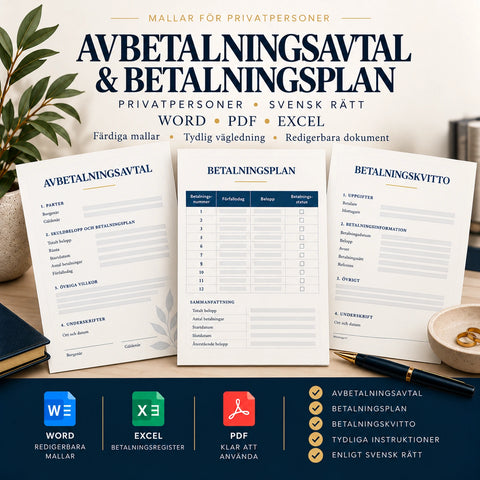
Installment Agreement & Payment Plan – Individual | Word/PDF/Excel
Word (DOCX), PDF, Excel (XLSX)
$8.00 USD
View template: Installment Agreement & Payment Plan – Individual | Word/PDF/Excel

Explore the topic
 Promissory notes – guides, rules & templates
Why use a promissory note for a private loan? 8 reasons and key terms
Why a promissory note is valuable for private loans: evidence, repayment, interest, installments, late payments, statute of limitations, and clarit...
 Disputing an invoice – guides, rules & templates
Disputed invoice, debt collection and the Swedish Enforcement Authority – what happens?
The process from a disputed invoice to debt collection, application for a payment order and potential court proceedings. See what you need to respo...
 Promissory notes – guides, rules & templates
Simple or negotiable promissory note – what is the difference?
Compare the two main categories of the Promissory Notes Act: simple promissory notes and negotiable bearer and order promissory notes. See how tran...


