

Om dokumentmallen
Mutual Non-Disclosure Agreement (NDA) template governed by Swedish law – an English-first confidentiality agreement for companies and other business parties that wish to share commercially sensitive information with one another while assessing a project, transaction, prospective partnership or similar business opportunity. This package includes an editable English main agreement, an English user guide, a Swedish reference agreement and a Swedish reference guide – each in DOCX and PDF.
Legal framework checked: 7 October 2026
This template is drafted with reference to the Swedish Trade Secrets Act (2018:558), including the amendments reflected in SFS 2025:1281, the Swedish Contracts Act, whistleblower protection legislation and applicable GDPR rules. It is a general business document for Swedish law, not a UK/US or universal international NDA.
What is included in the 2027 document package?
| English mutual NDA – DOCX + PDF | Editable 13-section agreement, including signature fields and an optional schedule of confidential information. |
| English user guide – DOCX + PDF | Step-by-step instructions on the parties, purpose, confidentiality, exclusions, duration, safeguarding information and signing. |
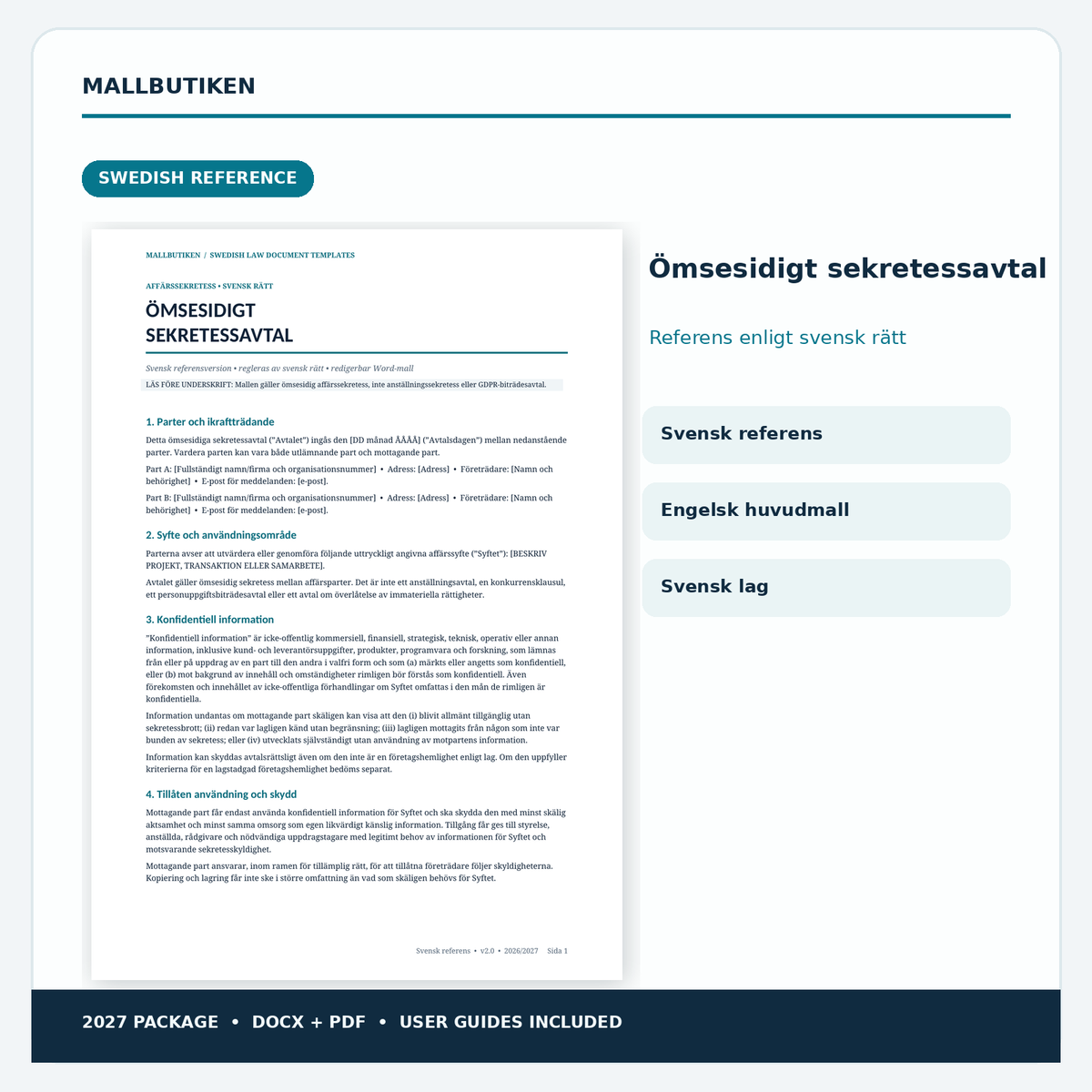
| Swedish reference agreement – DOCX + PDF | Corresponding Swedish-language reference using the concepts of Swedish contract and trade-secret law. |
| Swedish reference guide – DOCX + PDF | The same guidance in Swedish to help with terminology and practical completion. |
File count: 8 customer files. Formats: Word (.docx) and searchable A4 PDF. Delivery: Digital download; no physical product is shipped.
What is a mutual non-disclosure agreement?
A mutual NDA is a confidentiality agreement in which both parties can disclose and receive information. Each party agrees to protect confidential information received from the other and not to use it for an unauthorised purpose. Mutual arrangements are frequently useful during supplier assessments, joint product development, business discussions, due diligence and commercial negotiations.
This is a two-way business-to-business NDA. If one company will disclose information but the other will only receive it, a separate one-way NDA may be more suitable than this mutual template. This distinction is stated expressly in the document and its user guide.
Information that can be protected
The editable agreement allows the parties to define non-public confidential business information such as:
- Business plans, forecasts, budgets, profit margins and non-public pricing.
- Customer relationships, supplier arrangements and commercial strategies.
- Software source code, product designs, specifications, formulas and technical documentation.
- Unpublished research, product roadmaps, prototypes and internal operating processes.
- Non-public negotiations and other information that reasonably calls for confidentiality.
It covers information marked confidential as well as information that should reasonably be understood to be confidential in its context. The parties can add specific categories to an optional schedule.
Key clauses included in the template
- Purpose limitation: Information may be used only for a stated project or transaction.
- Standard exclusions: Public information, legitimately known information, lawful third-party disclosures and independent development.
- Reasonable security and need-to-know access: Protection through permitted personnel, advisers and contractors bound by appropriate confidentiality duties.
- Required disclosures: The agreement permits disclosures required by law or a binding authority decision.
- Protected reporting: Express preservation of legally protected whistleblowing and reporting of crimes or serious wrongdoing.
- Incident response: Prompt notice and reasonable mitigation after unauthorised disclosure or material loss, subject to law.
- Return and deletion: Handling of copies and reasonable exceptions for mandatory retention and backups.
- Intellectual property: No automatic transfer of ownership, licence or obligation to conclude a transaction.
- Term and continuing obligations: Editable duration and survival provisions, with specific treatment of qualifying statutory trade secrets.
- Liability and Swedish law: Remedies according to applicable law; no invented guarantee of compensation or automatic injunction.
Swedish trade secrets – when does statutory protection apply?
The Swedish Trade Secrets Act (2018:558) protects certain non-public business information when the statutory criteria are met. Those criteria include the information's commercial context, its lack of general availability, reasonable steps taken to keep it secret and the potential competitive harm of disclosure. Merely writing “confidential” does not automatically turn every document into a statutory trade secret.
An NDA may also provide contractual protection to information that does not qualify as a trade secret, depending on the agreement and applicable rules. The 2027 package makes this distinction explicit. Read the Swedish Trade Secrets Act on the Swedish Parliament's website.
A confidentiality agreement must not prevent protected whistleblowing
The agreement expressly permits disclosures required by law and preserves lawful reporting to authorities, protected whistleblowing and reporting of serious wrongdoing. The Swedish Trade Secrets Act does not classify information about crime or other serious wrongdoing as a trade secret, and separate legislation protects qualifying whistleblowers.
The NDA must not be used to evade mandatory legal rights or responsibilities. This is important when commercially sensitive information overlaps with regulatory concerns or alleged misconduct.
Duration: 12 months and three years are editable examples
The editable standard version starts with a 12-month agreement term and a three-year confidentiality period after the last relevant disclosure. These are drafting defaults, not statutory maximums, minimums or guarantees of enforceability. The appropriate terms depend on the information, the parties and the business context.
The agreement separately provides that information qualifying as a Swedish statutory trade secret remains subject to confidentiality while it retains that status and the restrictions are enforceable. This should not be misunderstood as a blanket promise that all information stays confidential forever.
What a mutual NDA does not cover
Important: an NDA is not automatically a non-compete agreement or a GDPR data-processing agreement.
Confidentiality restricts unauthorised disclosure and use of specified information; it does not by itself prevent someone from working for a competitor or operating a competing business. Unreasonable terms may be adjusted under Section 36 of the Swedish Contracts Act, and non-compete undertakings are additionally addressed by Section 38.
If one business processes personal data on behalf of another, a separate GDPR Article 28 data-processing agreement may be required. A confidentiality undertaking alone is insufficient. It does not in itself create a lawful basis for personal data processing. See the Swedish Authority for Privacy Protection's guidance.
This package is also not tailored to employment, public procurement secrecy, classified/security-sensitive data, specialist financial regulation, intellectual property licensing or complex cross-border disputes without further review.
When this NDA template is suitable
- Two Swedish companies are exploring a collaboration or supplier relationship.
- Both businesses may share financial or technical information during negotiations.
- A start-up and a prospective commercial partner want a mutual confidentiality framework.
- Companies need a Word/PDF confidentiality agreement in English while using Swedish law.
- The parties want a Swedish-language reference to assist their internal review.
When individual legal advice may be appropriate
- Only one party is disclosing information and a unilateral NDA would be more appropriate.
- The recipient is an employee, worker or individual consultant within a separate employment arrangement.
- The information includes large personal-data sets or requires a GDPR processor agreement.
- Intellectual property transfer, exclusivity, non-solicitation or non-compete restrictions are expected.
- The relationship is cross-border and relevant mandatory foreign law or jurisdiction rules may apply.
- The parties want fixed contractual penalties, special security terms, arbitration or bespoke remedies.
How to complete the NDA
- Open the English DOCX file and read the English user guide.
- Identify both parties by full legal name, registration number and authorised signatory.
- Describe a specific business Purpose rather than all possible future activities.
- Review the definition of Confidential Information and its exclusions.
- Choose realistic measures for disclosure, storage and access by advisers or contractors.
- Check the editable 12-month term, three-year confidentiality period, notification and return/deletion timeframes.
- Confirm that GDPR and any extra non-compete or IP arrangements are handled separately if required.
- Remove all unneeded drafting notes and blank placeholders, sign and retain copies.
English main version – Swedish reference
The English agreement is the primary customer document for this product. The Swedish version is included as a reference with corresponding terminology; both are expressly grounded in Swedish law. They are not represented as a universal US NDA, UK deed of confidentiality or general international contract.
Related templates
Frequently asked questions
Is this a one-way or mutual NDA?
It is mutual: each party can both disclose and receive confidential information. If only one party needs protection, consider a specifically drafted one-way agreement.
Is an English NDA automatically valid in Sweden?
An English-language agreement can be used under Swedish law, but its effect depends on the parties, signing authority, contractual wording and applicable law. Language alone does not guarantee validity or enforceability.
Does the NDA need witnesses or registration?
An ordinary Swedish-law business NDA generally does not require statutory witnesses or registration with a government authority. Reliable identification, signing authority and evidence of agreement remain important.
Can the NDA cover software source code and commercial plans?
Yes, when the information is properly described and the obligations are suitable. The agreement also provides a place to identify particularly important categories of information.
Can we add a penalty if someone breaches the NDA?
Possible penalty provisions require care and individual review. This standard version deliberately does not impose a fixed automatic penalty or guarantee compensation.
Does an NDA prevent someone from reporting misconduct?
No. Mandatory reporting rights, statutory disclosures and protected whistleblowing must be respected.
Does the agreement make us GDPR compliant?
No. GDPR obligations, including a processor agreement when required, must be addressed independently.
Legal references
Swedish Trade Secrets Act (2018:558), as amended through SFS 2025:1281; Swedish Contracts Act (1915:218), particularly Sections 36 and 38; Swedish Whistleblower Protection Act (2021:890); the GDPR and relevant guidance from the Swedish Authority for Privacy Protection (IMY).
Document package based on Swedish law as checked 7 October 2026. This is general legal-document support, not individual legal advice, and no standard template guarantees particular legal or financial outcomes.