Om dokumentmallen
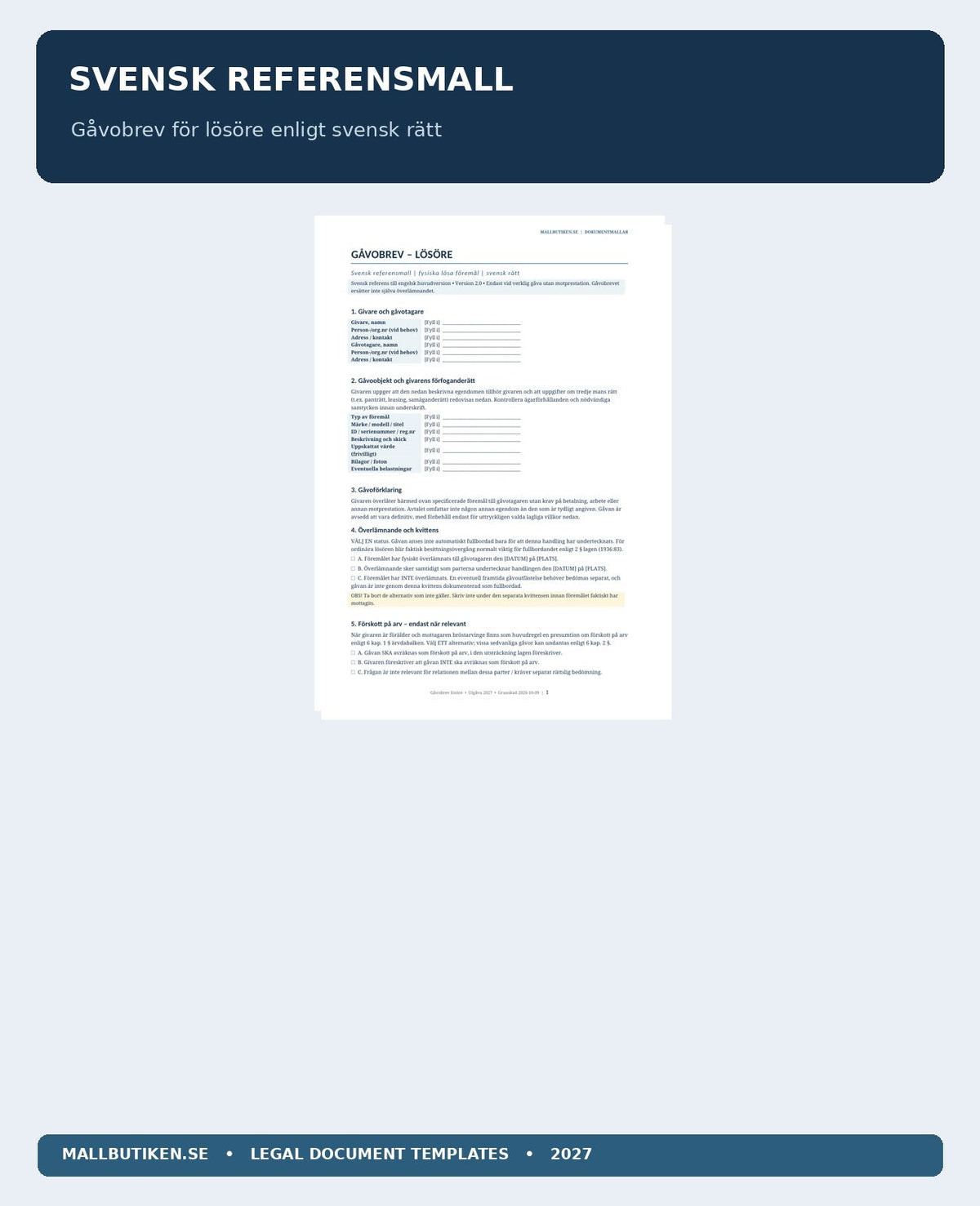
Deed of Gift – Movable Property (English), governed by Swedish law. An editable English-first document package for recording a genuine gift of ordinary physical movable items such as furniture, artwork, tools, equipment and collectables between private individuals. It helps identify the donated property, the donor and recipient, the circumstances of physical delivery, and any suitable inheritance or separate-property instructions.
The package has an English main deed and English user guide, with a Swedish reference deed and Swedish guide for terminology and communication in Sweden. English-language version governed by Swedish law — not a UK, US or universally valid international gift deed.
Based principally on Swedish Act (1936:83) concerning certain promises of gifts, the Swedish Inheritance Code and Swedish Marriage Code. For ordinary movable chattels, signing a document does not by itself establish that the gift has actually been completed.
What does this English gift deed package include?
| Document | What it is used for |
|---|---|
| 01. Deed of Gift – English main template | Donor, recipient, specific items, gift declaration, physical handover, inheritance, separate property, optional witnesses and receipt. |
| 02. English User Guide | Step-by-step completion guide, Swedish legal background, worked scenarios and important exceptions. |
| 03. Gåvobrev lösöre – Swedish reference | Swedish-language reference agreement with equivalent central fields. |
| 04. Svensk användarguide | Swedish reference instructions and legal checks. |
Eight customer files in total: all four documents in editable Word (DOCX) and searchable A4 PDF. The new 2027 ZIP delivery is connected to Digital Products separately by the shop owner; previously linked delivery files remain available until then.
Who can use this movable-property gift deed?
It may be suitable when someone gives a specific, clearly identifiable physical movable item to another person without receiving money, services or other consideration in return. A written deed can help establish the donor's intention and record the item, selected conditions and evidence of delivery. It does not replace proof of ownership or mandatory transfer steps.
- Gifting identified artwork or antiques to an adult child or relative.
- Documenting the transfer of privately owned furniture, equipment, tools or collectables.
- Recording the donor's instruction about advancement of inheritance, where applicable.
- Including a separate-property condition for a qualifying gift from a third party.
What the deed regulates
1. Identify the donor, recipient and item precisely
Enter full names and relevant contact or identification details. Describe the item by type, brand, title, model, serial number, condition and supporting photographs. Verify that the donor owns and may lawfully dispose of it. An item under a pledge, financed-purchase arrangement, lease or co-ownership agreement may require special treatment or consent.
2. Genuine gift and actual delivery
Under sections 1–2 of Swedish Act (1936:83), an uncompleted promise of a gift and a completed gift can have different legal effects. For ordinary chattels, the item generally needs to come into the recipient's possession for the gift to be completed. The English deed has three mutually exclusive delivery-status options and a separately signed receipt. Sign the receipt only after the item has actually been received.
A written gift promise handed to the recipient can have an effect between the parties under certain conditions, but signing alone does not necessarily protect the recipient against the donor's creditors. Assets held by third parties or requiring registration need an asset-specific assessment.
3. Advancement of inheritance
Chapter 6, section 1 of the Swedish Inheritance Code generally treats gifts from a parent to a descendant as advances on inheritance unless the donor directed otherwise or circumstances support a different result. The deed lets the donor choose whether the gift should count as an advancement or expressly should not, or mark the question inapplicable. Special rules apply to customary gifts and some inheritance situations; forced-heirship issues can remain relevant.
4. Separate-property conditions
Under Chapter 7, section 2 of the Swedish Marriage Code, a gift from someone other than the recipient's spouse can, in appropriate circumstances, be designated as the recipient's separate property. The deed includes separate choices concerning substituted property and income generated by the asset. A third-party gift clause cannot automatically achieve the same outcome for a gift between spouses.
5. Handover receipt and optional witnesses
Both the donor's declaration and the recipient's actual receipt can be documented. Two witnesses are not a general statutory requirement for a normal gift of movable chattels. The optional witness fields are included for evidentiary purposes and do not replace physical delivery or special statutory formalities.
When this template is not sufficient
- Swedish real estate or site-leasehold: special transfer and registration rules apply.
- Housing co-operative units (bostadsrätt): legally movable property in a broad sense, but separate written transfer and membership requirements apply.
- Cash gifts, financial instruments, debts or account-held securities: completion rules differ; use a specific form.
- Registered vessels, aircraft and certain vehicles: there may be asset-specific registrations, ownership evidence and insurance steps.
- Gifts between spouses: Swedish Marriage Code Chapter 8 introduces special rules. A future gift promise during marriage is ineffective and registration with Skatteverket can be important for protection against creditors.
- Gifts to minors or complicated family situations: representation, conflicts of interest, guardianship and inheritance rules can require additional review.
- Cross-border gifts: foreign law, tax residence, bank requirements and translation acceptance need individual examination.
How to use the English main document
- Open the English DOCX and read the separate English User Guide.
- Identify both parties and specify each gifted item precisely; attach photos if useful.
- Check the donor's ownership, any security interests and whether the transfer involves actual consideration.
- Select one of the delivery alternatives. Delete the two unused alternatives.
- Consider the advancement-of-inheritance choices if there is a relevant family relationship.
- Choose a separate-property condition only where legally suitable, and decide whether income from the item should be included.
- Remove remaining placeholders and inappropriate special clauses, then arrange valid signatures.
- Physically hand over the item and complete the separate receipt only after actual delivery.
- Retain the deed, dated receipt, photographs, ownership records and relevant documents securely.
Practical example: a gift of artwork
A parent wishes to give an identified painting to an adult child. The deed states the artist, work title, identifying details and condition; the donor selects whether the painting will count as an advancement of inheritance and, if appropriate, specifies separate property. The physical transfer is documented with a date and a receipt when the recipient actually takes possession. This example is illustrative and does not guarantee the legal outcome in a particular case.
Common mistakes to avoid
- Assuming two witnesses are always mandatory for gifts of movable property.
- Signing a receipt before the item has actually been delivered.
- Using a vague description such as “some furniture” without any identifying details.
- Treating goods exchanged for consideration as a pure gift.
- Confusing the rules on separate property for third-party gifts with transfers between spouses.
- Failing to check special transfer, registration or creditor-protection requirements.
Frequently asked questions
Is this an English deed of gift governed by Swedish law?
Yes. The main deed and guide are in English, but the legal framework is Swedish. They are not UK or US legal forms.
Do I need two witnesses?
Not generally for an ordinary movable chattel under Swedish law. Optional witness signatures can still help with evidence.
Does signing the gift deed automatically complete the transfer?
No. For ordinary movable items, actual transfer of possession is generally important. The signed document and the receipt serve different purposes.
Can I exclude a gift from advancement of inheritance?
A donor can often give an express direction that a gift to a descendant is not to be treated as an advancement. Other succession rules can still be relevant.
Can the recipient hold an item as separate property?
In appropriate third-party gift situations, yes. Spousal gifts require a different assessment and might require a marital property agreement for the desired result.
Do gifts between spouses have to be registered?
Not every gift requires registration to be effective between spouses, but registration with the Swedish Tax Agency can matter for protection against the donor's creditors. Certain personal presents are subject to an exception.
Is this suitable for a bostadsrätt?
No, not as a standalone transfer deed. Separate Swedish housing co-operative transfer rules apply.
What language versions are included?
The English main deed and English guide, plus the Swedish reference deed and Swedish guide, each in DOCX and PDF (eight files total in the new package).
Related Mallbutiken templates
- Gåvobrev för lös egendom – Swedish main product
- Gåvobrev för pengar – monetary gift deed
- Gåvobrev för bostadsrätt – specialist form
Official Swedish legal sources
- Swedish Act (1936:83) concerning certain promises of gifts, especially sections 1–4.
- Swedish Inheritance Code (1958:637), Chapter 6, sections 1–2.
- Swedish Marriage Code (1987:230), Chapters 7–8.
- Swedish Tax Agency – gifts between spouses.
Edition 2027; Swedish legal framework reviewed 9 October 2026. This is a general documentation and drafting aid, not individualized legal or tax advice. No guarantee is given concerning validity, completion, creditor protection, acceptance in another country or fitness for every situation.