

Om dokumentmallen
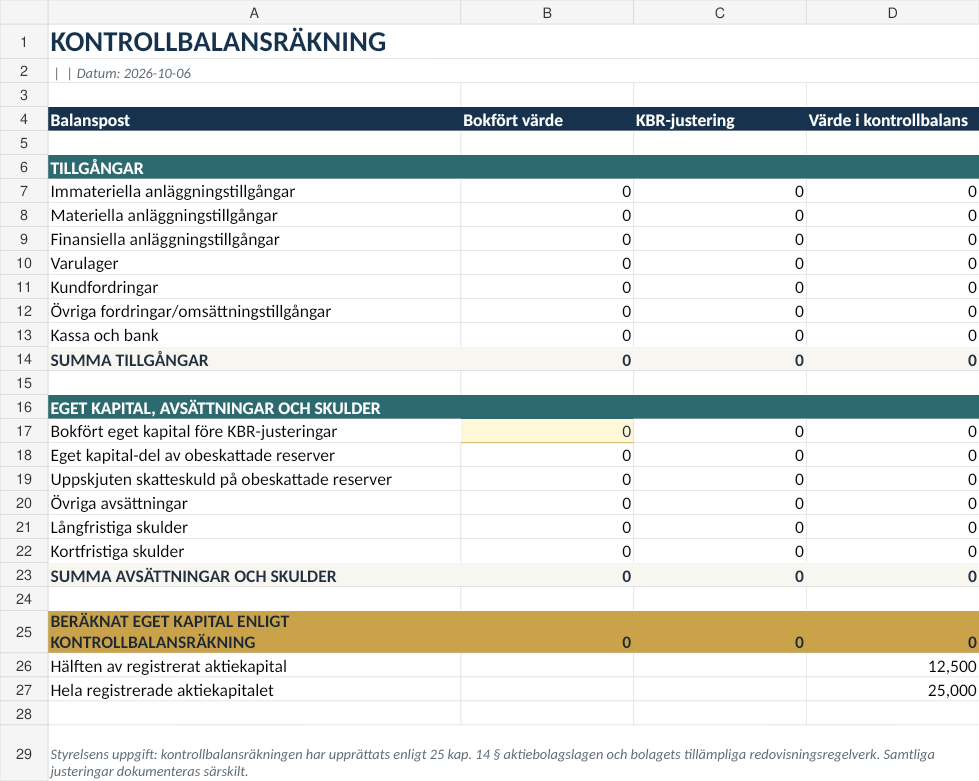
Control Balance Sheet – English-first Excel template under Swedish law for Swedish limited companies that need to assess capital deficiency under Chapter 25 of the Swedish Companies Act. The package includes an automated English Excel workbook, a Swedish reference workbook, printable PDF versions and detailed user guides in both languages.
Legally and accounting reviewed: 6 October 2026
Reviewed against Chapter 25 of the Swedish Companies Act, current BFN guidance on control balance sheets, K2/K3 principles and current Swedish corporate tax rules.
What is included?
| English Control Balance Sheet – Excel | Automated workbook with inputs, adjustments, capital tests, checks and board signatures. |
| English printable PDF | Static printout for documentation and manual completion. |
| Swedish reference Excel + PDF | Matching Swedish reference versions for boards, accountants and advisers. |
| English + Swedish user guides | Detailed Word/PDF guides covering the legal process, valuation adjustments and common mistakes. |
A control balance sheet is not an insolvency test
The statutory trigger concerns capital deficiency. The board must immediately prepare a control balance sheet when there is reason to assume that equity, calculated under Chapter 25 section 14, is below one half of the registered share capital, or when the Act's separate enforcement trigger is met. Insolvency and inability to pay debts are separate legal questions.
Automated legal thresholds
The Excel workbook calculates and displays:
- equity according to the control balance sheet,
- one half of registered share capital,
- the full registered share capital,
- a capital-status warning,
- guidance for the second control meeting date when a first control meeting date is entered,
- auditor-status reminders.
Half the share capital vs full share capital
If the control balance sheet shows equity below one half of registered share capital, the board must as soon as possible call a first control meeting to consider liquidation. If the first control meeting does not show that the full registered share capital has been restored and liquidation is not resolved, a second control meeting must generally be held within eight months. It is therefore not sufficient merely to restore the company to the half-capital threshold before the second meeting.
Built for Chapter 25 section 14 adjustments
The workbook separates ordinary book values from control-balance adjustments and provides dedicated documentation fields. It supports:
- permitted asset-value adjustments where supported by generally accepted accounting principles,
- net selling value where the statutory conditions are met,
- permitted reductions of provisions or liabilities,
- separate documentation of every adjustment,
- splitting untaxed reserves into an equity component and deferred tax liability.
Untaxed reserves and tax calculation
The workbook automatically splits untaxed reserves using a tax-rate input. It defaults to 20.6%, the current Swedish corporate income tax rate, but the input is editable because the actual tax effect should always be verified for the company and the specific balance-sheet item.
K2 and K3
BFN states that a smaller company may use K3 instead of K2 when preparing a control balance sheet. A larger company may not use K2, and K2 and K3 should not be mixed in the same control balance sheet. The workbook therefore includes a clear K2/K3 framework selection and the user guide explains the distinction.
Auditor and board signatures
If the company has an auditor, the auditor reviews the control balance sheet. The control balance sheet itself must be signed by the board. The workbook includes an auditor-status field and a separate board-signature sheet.
Personal liability risk
Failure to follow the statutory control-balance-sheet procedure can lead to personal payment liability for company obligations incurred during the period of non-compliance. The package therefore emphasises dates, documentation, board process and the distinction between the first and second control meetings.
Workbook structure
- START – company details, share capital, date, K2/K3, auditor status and tax rate.
- ADJUSTMENTS – ordinary book values, permitted KBR adjustments and supporting documentation.
- CONTROL BALANCE – automated balance and capital calculations.
- CHECKS – formula-based warning and plausibility checks.
- SIGNATURES – dedicated board-signature page.
English + Swedish in one package
The English workbook is the primary version in this product. The Swedish workbook is included as a reference for Swedish boards, accountants, auditors and advisers. This is an English-language template governed by Swedish law, not a foreign-law balance-sheet template.
Company has an auditor? See the Swedish-first package with auditor workflow →
Important scope
The package is designed for ordinary non-financial Swedish limited companies. Financial undertakings and companies subject to sector-specific capital or accounting rules may require other treatment. Asset revaluations, disputed claims, complex tax effects, group structures or uncertainty about personal liability should be reviewed by a qualified accountant, auditor or lawyer.
File formats and delivery
Formats: XLSX, PDF, DOCX and ZIP.
Languages: English and Swedish.
Number of files: 8.
Delivery: digital download. No physical product is shipped.
Frequently asked questions
When must a control balance sheet be prepared?
Immediately when the board has reason to assume that equity, calculated under the statutory control-balance rules, is below one half of registered share capital, or when the separate enforcement trigger in the Act is met.
Is the control balance sheet an insolvency test?
No. Capital deficiency and insolvency are different legal questions.
Must an auditor review it?
If the company has an auditor, the auditor reviews the control balance sheet. The workbook itself can also be used by companies without an auditor, but the company's actual auditor status must be verified.
Does half the share capital need to be restored within eight months?
No. If the process continues to a second control meeting, the relevant restoration level is the full registered share capital, not merely half.
Can K2 and K3 be mixed?
No. BFN's guidance indicates that the frameworks should not be mixed in the same control balance sheet.
This package is a calculation and documentation aid under Swedish law and does not replace individual accounting, audit or legal advice.